AI Digital Marketing Syllabus: Full Course Guide 2026
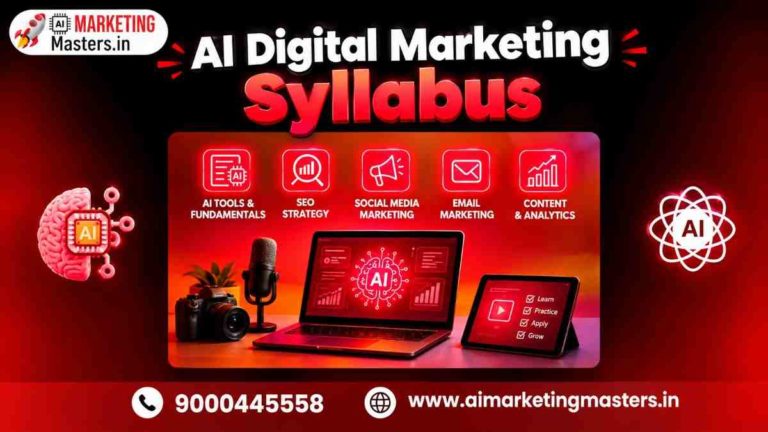
An AI Digital Marketing Syllabus is a structured curriculum that blends traditional marketing fundamentals with artificial intelligence skills. It typically covers AI basics, prompt engineering, AI-powered SEO, generative content creation, social media marketing, PPC, email marketing, automation, analytics, and hands-on projects. The goal is to prepare learners to plan, execute, and optimize marketing campaigns using both strategic thinking and modern AI tools.
★★★★★
4.9/5 rated by 1329+ students · Google Verified
Table of Contents
Introduction
Digital marketing has always been about reaching the right audience with the right message at the right time. What has changed is the speed and scale at which this now happens, largely because of artificial intelligence. AI digital marketing refers to the practice of using AI tools and techniques — for content creation, research, personalization, automation, and analysis — alongside proven marketing strategy.
This is exactly why an AI Digital Marketing Syllabus has become so important. A well-designed syllabus doesn’t just teach you how to use a chatbot to write captions. It walks you through digital marketing fundamentals first, then layers on AI skills like prompt engineering, AI-assisted SEO, generative content workflows, and automation, so you understand both the “why” and the “how.”
Traditional marketing skills like audience research, funnel building, and copywriting haven’t disappeared — they’ve become more valuable because AI tools now handle repetitive tasks, freeing marketers to focus on strategy, creativity, and decision-making. Companies across sectors are adopting AI for content production, ad optimization, customer segmentation, chatbots, and reporting, which means marketers who understand how to direct and supervise these tools are in a stronger position than those who don’t.
For students, freshers, working professionals looking to upskill, people returning after a career break, and business owners who want to market smarter, learning through a structured AI Digital Marketing Syllabus offers a practical path forward. India’s digital economy continues to expand, and with it, the demand for marketers who can combine classic marketing knowledge with modern AI fluency — and Hyderabad, with its strong IT, SaaS, and startup base, is one of the more active hubs for this kind of hiring. This article breaks down what such a syllabus typically includes, why it matters, and how it can shape a career, whether you’re learning independently or through a structured program like the Digital Marketing with AI Course in Hyderabad.
AI Digital Marketing Syllabus
What is an AI Digital Marketing Syllabus?
An AI Digital Marketing Syllabus is a structured learning path that combines core digital marketing concepts with AI tools and techniques used to plan, create, and optimize campaigns.
Rather than treating AI as an add-on, a well-built syllabus integrates it into every stage of the marketing process. This usually starts with the fundamentals — how digital marketing works, who the audience is, and what a marketing funnel looks like — before introducing AI concepts such as generative AI, prompt engineering, and automation.
A typical syllabus covers
- Digital marketing fundamentals
- AI fundamentals and how generative AI works
- Prompt engineering for marketing tasks
- AI-assisted SEO and content optimization
- AI content creation across formats
- Social media marketing with AI support
- Paid advertising (PPC) with AI-assisted bidding and creative testing
- Email marketing and automation
- Marketing automation and CRM workflows
- Analytics and data-driven decision-making
- Conversion rate optimization
- Customer and competitor research
- AI marketing tools across categories
- Practical, portfolio-ready projects
The idea is not to replace human judgment with AI output, but to teach learners how to use AI as a productivity layer on top of solid marketing strategy. A good syllabus will always emphasize supervision, fact-checking, and originality alongside the technical skills.
Why Learn an AI Digital Marketing Course in 2026?
The marketing landscape has shifted noticeably over the past few years. Generative AI tools are now common in content teams, and many routine tasks — first drafts, keyword clustering, ad variations, email subject lines — are increasingly AI-assisted before a human refines them.
A few shifts make this a meaningful time to build AI marketing skills
- Automation of repetitive tasks. Reporting, basic content drafts, and campaign monitoring can be partially automated, giving marketers more time for strategy.
- AI-assisted content production. Teams can generate more content variations for testing, provided there’s strong human editing behind it.
- Personalization at scale. AI makes it easier to tailor messaging to different audience segments without manually rewriting everything.
- Predictive and faster optimization. Campaign data can be analyzed more quickly, helping marketers adjust budgets and creatives sooner.
- Changing search behavior. With AI Overviews and answer-engine-style search results becoming more common, marketers need to understand how content gets surfaced in these new formats, not just traditional blue-link results.
- Growth of zero-click searches. More users get answers directly on the search results page, which changes how visibility and brand awareness should be measured.
- Importance of first-party data. As privacy rules tighten, marketers who know how to responsibly collect and use first-party data have an advantage.
None of this means AI replaces marketers. It’s more accurate to view AI as a productivity and decision-support technology — it helps you move faster and test more ideas, but strategy, brand judgment, empathy for the customer, and ethical oversight still need a human. This is exactly the balance a good AI Digital Marketing Syllabus tries to teach.
AI Digital Marketing Syllabus — Core Modules at a Glance
A complete AI digital marketing curriculum is usually organized into a handful of skill clusters. Here’s a quick overview of what each one covers
- Digital marketing fundamentals — channels, the marketing funnel, customer journey, buyer personas, and branding basics.
- AI fundamentals — machine learning basics, generative AI, large language models, and where AI needs human oversight.
- Prompt engineering — writing effective, role-based, and context-based prompts for content, SEO, ads, and research. Anyone who wants to go deep on this can look at a dedicated prompt engineering course rather than treating it as a side skill.
- AI-powered SEO — keyword research, semantic SEO, on-page and technical SEO, plus the newer disciplines of AEO, GEO, and LLMO. This area has grown enough that it’s often taught as its own specialization — see a Generative Engine Optimization training track if you want to focus there.
- AI content marketing — blog writing, content briefs, repurposing, and email/social copy, always paired with human editing and E-E-A-T. For learners who want to specialize in writing itself, an AI content writing course goes much deeper into this single module.
- AI social media marketing — strategy, caption and hashtag support, social listening, and light automation.
- AI-powered PPC — Google Ads and Meta Ads fundamentals, AI-assisted bidding, creative testing, and ROAS analysis.
- AI email marketing and automation — segmentation, drip campaigns, CRM workflows, and trigger-based journeys.
- AI analytics and CRO — Google Analytics, KPIs, attribution, and conversion rate optimization.
- AI marketing tools — general AI assistants (ChatGPT, Claude, Gemini, Copilot) for research and drafting, plus specialized tools for design and visuals (AI graphic design, AI image creation) and video (AI video creation).
This is a summary view. If you want the full, module-by-module curriculum — down to individual topics and tools taught in each one — it’s worth going through the complete AI Digital Marketing Syllabus in detail.
AI Digital Marketing Skills You Should Learn
Beyond the syllabus modules, certain core skills consistently separate strong AI-powered marketers from the rest
- SEO and keyword research
- Content strategy and copywriting
- Prompt engineering
- Generative AI literacy
- Social media marketing
- PPC and paid media management
- Email marketing
- Marketing automation
- Analytics and data interpretation
- Conversion optimization
- Customer and market research
- Clear communication
- Creativity and strategic thinking
- Critical thinking and fact-checking
- Basic awareness of AI ethics and responsible use
It’s worth repeating: AI tools alone are not enough. A marketer who understands audience psychology, brand positioning, and business goals will always get more value out of AI tools than someone who relies on them without a strategic foundation.
AI Digital Marketing Career Opportunities in India
Learning AI-powered digital marketing opens doors across a wide range of roles, including
- Digital Marketing Executive
- AI Digital Marketing Specialist
- SEO Specialist / AI SEO Specialist
- Content Marketing Specialist
- Social Media Manager
- Performance Marketing Specialist
- PPC Specialist
- Email Marketing Specialist
- Marketing Automation Specialist
- Digital Marketing Analyst
- Growth Marketing Specialist
- AI Marketing Consultant
- Content Strategist
- Digital Marketing Manager
These opportunities exist for freshers building their first career, experienced professionals adding AI skills to their existing marketing background, people returning to work after a career gap, freelancers building an independent client base, entrepreneurs marketing their own businesses, and agency professionals managing multiple client accounts. For a closer, role-by-role look at what these positions actually involve and typical hiring patterns, see this breakdown of AI-powered digital marketing jobs.
AI Digital Marketing Salary in India
Salary expectations in this field vary widely based on skills, location, industry, and experience, but a rough pattern holds across the market: freshers typically start in the ₹3–6 LPA range, mid-level specialists move into ₹6–12 LPA, and senior managers or strategists can reach ₹18–30+ LPA and beyond, depending on scope and company size.
Actual salaries depend on your skill set, city, company size and industry, portfolio of work, certifications, and how effectively you can use AI tools to improve outcomes — so treat any single number as a reference point rather than a guarantee. For a detailed, experience-wise breakdown with role-specific ranges and the skills that push pay higher, see this AI digital marketing salary guide.
Industries Hiring AI Digital Marketing Professionals
AI-powered marketing skills are useful across a wide spread of industries, including IT and software, e-commerce, SaaS, EdTech, FinTech, healthcare, real estate, travel and hospitality, retail, digital agencies, B2B companies, startups, and manufacturing. Nearly every sector now has some form of online presence to manage, which is why marketers with both strategic and AI skills are valued broadly rather than in just one niche.
Top Companies Hiring Digital Marketing Professionals in India
Large technology, e-commerce, consulting, and SaaS companies — such as Amazon, Google, Microsoft, Accenture, Deloitte, TCS, Infosys, Wipro, HCLTech, Flipkart, Zoho, and Salesforce — regularly hire for digital marketing roles across various levels. This doesn’t mean every company has an “AI Digital Marketing” job title open at any given time; job titles, team structures, and hiring needs change frequently. Always check current openings directly with the company or reliable job platforms rather than relying on a fixed list.
AI Digital Marketing Career Path
A typical progression looks like this
Beginner → Digital Marketing Executive Focus on learning fundamentals — SEO basics, social media posting, basic analytics, and assisting with campaigns.
Intermediate → SEO / PPC / Social Media / Content Specialist Specialize in one or two channels, start using AI tools for research and drafting, and take ownership of specific campaigns.
Advanced → AI Digital Marketing Specialist / Growth Marketer Manage multi-channel campaigns, use AI for optimization and automation, and start contributing to strategy.
Expert → Digital Marketing Manager / AI Marketing Strategist / Consultant Lead teams, set overall marketing strategy, oversee AI adoption across the marketing function, and manage budgets and stakeholder relationships.
AI Digital Marketing Career Roadmap
Level | What to Learn | Practical Goal |
Beginner | Digital marketing fundamentals, SEO, content, social media | Build marketing fundamentals |
Intermediate | PPC, analytics, email, automation, AI tools | Run complete campaigns |
Advanced | AI SEO, GEO, AEO, automation, data analysis | Optimize AI-powered campaigns |
Expert | Strategy, leadership, AI transformation, consulting | Lead marketing growth |
At each stage, pair your learning with a project: a beginner might build a small content calendar, while an advanced learner could design a full AEO/GEO-optimized content strategy for a sample brand.
Certifications That Can Boost an AI Digital Marketing Career
Certifications can add credibility to a resume, especially early in your career. Commonly useful ones include Google Ads certifications, Google Analytics-related certifications (both free through Google’s own Skillshop platform), HubSpot’s content marketing certification, the Meta Certified Digital Marketing Associate credential, general SEO certifications, and other AI-focused marketing credentials.
That said, certifications work best alongside practical experience. A portfolio of real campaigns, measurable results, and hands-on projects usually matters just as much — often more — than a certificate alone when it comes to hiring decisions.
AI Digital Marketing Tools Every Marketer Should Know
AI Writing and Research
ChatGPT, Claude, Gemini, and Perplexity are commonly used for research, ideation, and first-draft content, always followed by human review and fact-checking.
SEO
Tools like Google Search Console, Google Trends, and various keyword research and SEO analysis platforms help with technical SEO, keyword discovery, and performance tracking.
Design
Canva AI and other AI image-generation platforms speed up the creation of social graphics, ad creatives, and presentation visuals.
Analytics
Google Analytics, Looker Studio, and Search Console help marketers understand traffic, behavior, and campaign performance.
Automation
CRM platforms, email automation tools, and workflow automation software help manage lead nurturing and repetitive marketing tasks at scale.
Rather than memorizing every tool, focus on understanding what each category is meant to solve — research, content creation, SEO, design, analytics, or automation — so you can adapt as new tools enter the market.
AI Digital Marketing vs Traditional Digital Marketing
Factor | Traditional Digital Marketing | AI-Powered Digital Marketing |
Content Creation | Mostly manual | AI-assisted + human edited |
Research | Manual + tools | AI-assisted research |
Personalization | Rule-based | More data-driven |
Automation | Limited/moderate | Extensive |
Analytics | Manual interpretation | AI-assisted insights |
Productivity | Depends heavily on manual work | Higher workflow efficiency |
Human Role | Strategy + execution | Strategy, supervision + decision-making |
AI-powered marketing doesn’t remove the need for marketing fundamentals — it changes how those fundamentals are executed day to day.
AI Digital Marketer vs Data Analyst
An AI Digital Marketer’s main objective is to plan and execute campaigns that drive traffic, leads, and conversions, using AI tools for content, ads, and automation. A Data Analyst’s main objective is to interpret data — marketing or otherwise — to uncover patterns and support decisions across the business.
Daily work differs too: marketers spend time on campaign planning, content, and channel management, while analysts focus on data cleaning, querying, visualization, and reporting. Marketers need creativity, communication, and strategic thinking; analysts need strong statistical and technical skills. Career paths can overlap — a marketer with strong analytics skills can move into marketing analytics roles, and an analyst interested in campaigns can move toward growth marketing.
Why AI Digital Marketing is One of the Best IT and Digital Careers in India
Several factors make this field attractive for Indian learners right now: growing AI adoption across companies of all sizes, ongoing digital transformation, rising online competition that pushes businesses to market smarter, demand for measurable and accountable marketing spend, expanding e-commerce and SaaS sectors, increasing content requirements across websites and social platforms, the rise of AI-powered search experiences, and new roles emerging specifically around AI-assisted marketing.
There’s also flexibility built into this career — freelancing, agency work, remote roles, and entrepreneurship are all realistic paths, not just full-time employment. That said, success in this field depends on continuously learning, building real project experience, understanding marketing fundamentals deeply, and staying adaptable as AI technologies keep evolving. It’s a promising field, but not a guaranteed shortcut — consistent effort still matters.
Practical Projects to Include in an AI Digital Marketing Course
Hands-on projects are what turn syllabus knowledge into a job-ready portfolio. Useful examples include
- Build an SEO content strategy for a sample website or business
- Perform AI-assisted keyword research for a specific niche
- Create a 30-day content calendar across blog and social media
- Build a complete Google Ads campaign plan
- Create a social media strategy for a brand
- Develop an email automation workflow for lead nurturing
- Optimize a landing page for conversions
- Create an end-to-end AI-powered content workflow
- Conduct competitor research for a chosen industry
- Build a simple marketing performance dashboard
- Create an AEO/GEO content strategy for AI-powered search
- Develop a complete, multi-channel digital marketing campaign
These projects give recruiters something concrete to evaluate, beyond a certificate or resume line.
How to Choose the Right AI Digital Marketing Course
Before enrolling in any course, evaluate it on the following
- Depth and relevance of the syllabus
- Trainer’s real-world experience
- Number and quality of practical projects
- Exposure to live or simulated campaigns
- Which AI tools are actually covered
- Quality of SEO, PPC, and analytics training
- Support for building a portfolio
- Placement support (and how it’s actually structured)
- Course duration and learning format (online, offline, hybrid)
- Whether the curriculum is updated regularly
- Genuine student reviews
- Availability of a demo class before enrolling
Be cautious of any course that promises guaranteed jobs or specific salary figures — no legitimate program can guarantee employment outcomes, since hiring depends on many factors beyond the course itself. If you’re weighing whether you meet the basic requirements before enrolling anywhere, it’s worth checking a program’s eligibility criteria first, and comparing the available training modes (one-on-one, institutional, college, or corporate) to see what fits your schedule.
How to Start a Career After Learning AI Digital Marketing
- Learn digital marketing fundamentals thoroughly
- Build a working understanding of AI fundamentals
- Practice prompt engineering for marketing tasks
- Study SEO in depth, including AI-assisted techniques
- Learn paid advertising basics (Google Ads, Meta Ads)
- Get comfortable with analytics tools and KPIs
- Understand marketing automation workflows
- Complete multiple practical projects
- Build a portfolio showcasing real (or simulated) campaigns
- Optimize your LinkedIn profile and resume around these skills
- Apply for roles matching your current skill level
- Keep learning as new AI marketing tools and techniques emerge
Freshers should prioritize building a strong portfolio through projects and internships, since they may not have prior campaign experience to show. Experienced professionals, on the other hand, should focus on demonstrating how they’ve integrated AI into existing marketing workflows and the measurable impact it has had — this is often more persuasive to employers than starting from scratch. If you’d rather work through this list with a structured curriculum, live projects, and placement support instead of self-teaching from scratch, the Digital Marketing with AI Course in Hyderabad covers all twelve steps hands-on.
Market Demand and Trends
The broader context behind this syllabus is a fast-changing digital landscape. Businesses are increasingly investing in digital advertising as more commerce and customer interaction moves online. Generative AI adoption is growing across content, design, and customer service functions, and marketing automation is becoming standard practice rather than an advanced tactic reserved for large enterprises.
Search behavior itself is evolving, with AI-driven summaries and conversational search interfaces changing how content gets discovered. This has increased the importance of skills like AEO and GEO — not as replacements for SEO, but as extensions of it.
For specific figures — such as exact market sizes, employment numbers, or adoption percentages — it’s best to consult current reports from sources like NASSCOM, Statista, Google, Microsoft, Meta, HubSpot, IBM, the World Economic Forum, and Government of India publications, since these statistics update frequently and vary by methodology. Treating any single number as fixed can be misleading; look at trends across multiple recent reports instead. For a technical, first-party look at how AI Overviews and AI Mode actually work in Google Search, Google’s own AI features documentation is a more reliable starting point than third-party interpretations.
How to Start a Career After Learning AI Digital Marketing
- Learn digital marketing fundamentals thoroughly
- Build a working understanding of AI fundamentals
- Practice prompt engineering for marketing tasks
- Study SEO in depth, including AI-assisted techniques
- Learn paid advertising basics (Google Ads, Meta Ads)
- Get comfortable with analytics tools and KPIs
- Understand marketing automation workflows
- Complete multiple practical projects
- Build a portfolio showcasing real (or simulated) campaigns
- Optimize your LinkedIn profile and resume around these skills
- Apply for roles matching your current skill level
- Keep learning as new AI marketing tools and techniques emerge
Freshers should prioritize building a strong portfolio through projects and internships, since they may not have prior campaign experience to show. Experienced professionals, on the other hand, should focus on demonstrating how they’ve integrated AI into existing marketing workflows and the measurable impact it has had — this is often more persuasive to employers than starting from scratch. If you’d rather work through this list with a structured curriculum, live projects, and placement support instead of self-teaching from scratch, the Digital Marketing with AI Course in Hyderabad covers all twelve steps hands-on.
Key Takeaways
- An AI Digital Marketing Syllabus blends core marketing fundamentals with AI skills like prompt engineering, AI-assisted SEO, and generative content creation.
- Success requires both technical AI fluency and traditional marketing skills — strategy, creativity, and critical thinking remain essential.
- India offers a wide range of career opportunities, from entry-level executive roles to senior AI marketing strategist and consultant positions.
- Practical, portfolio-ready projects matter as much as, or more than, certifications when building credibility with employers.
- The field is evolving quickly, so continuous learning and adapting to new AI tools and search behaviors are necessary for long-term career growth.
Conclusion
AI is reshaping how digital marketing gets planned, created, and measured, but it hasn’t replaced the fundamentals that make marketing effective in the first place. A well-structured AI Digital Marketing Syllabus reflects this balance — it teaches core marketing strategy alongside practical AI skills like prompt engineering, AI-assisted SEO, content creation, automation, and analytics.
For learners in India, this combination opens up real career opportunities, whether you’re a fresher starting out, a professional looking to upskill, someone returning after a career break, or a business owner trying to market more effectively. What matters most is prioritizing practical experience — building real projects, understanding your audience, and learning to use AI tools thoughtfully rather than blindly.
There are no guaranteed outcomes in any career path, and AI digital marketing is no exception. But for those willing to put in consistent effort, keep learning, and build a genuine portfolio of work, it’s a field with meaningful room to grow. If you’re ready to start, begin with the fundamentals, get comfortable with a few core AI tools, and work on real projects — that combination is what will actually move your career forward. You can explore the complete Digital Marketing with AI course for structured, mentor-led training, or get in touch with any questions before you enroll.
FAQ
- What is an AI Digital Marketing Syllabus?
It’s a structured curriculum that combines digital marketing fundamentals — SEO, content, social media, PPC — with AI skills like prompt engineering, generative content creation, and automation, so learners can plan and execute campaigns using both strategy and modern tools.
- What topics are covered in an AI digital marketing course?
Most courses cover digital marketing basics, AI fundamentals, prompt engineering, AI-powered SEO, content marketing, social media marketing, PPC, email marketing, automation, analytics, conversion optimization, and hands-on projects using popular AI tools.
- Is AI digital marketing good for beginners?
Yes, as long as the course starts with marketing fundamentals before introducing AI tools. Beginners benefit most from a syllabus that builds a strong base in strategy and audience understanding first.
- What AI tools should digital marketers learn?
Common tools include general AI assistants like ChatGPT, Claude, and Gemini for content and research, Canva AI for design, SEO platforms for keyword research, and automation tools for email and CRM workflows.
- Is AI digital marketing a good career in India?
It has strong potential given growing digital adoption across industries, though outcomes still depend on individual skill-building, portfolio quality, and consistent learning rather than the course alone.
- What is the salary of an AI digital marketer in India?
Salaries vary widely by experience and role, roughly ranging from ₹3–6 LPA for freshers to ₹18–30+ LPA for senior strategists or managers, though actual figures depend on skills, location, and company.
- Do I need coding skills to learn AI digital marketing?
No, coding is not required. Most AI marketing tools are designed with no-code or low-code interfaces; understanding prompts, strategy, and data interpretation matters more than programming.
- How long does it take to learn AI digital marketing?
This depends on the course structure and your pace, but a foundational understanding can typically be built over a few months of consistent study, with ongoing learning needed as tools and techniques evolve.
- What certifications are useful for AI digital marketing?
Google Ads, Google Analytics, HubSpot, Meta, and various SEO and AI-focused marketing certifications can strengthen a resume, though practical project experience is equally important to employers.
- What is the future of AI digital marketing in India?
The field is expected to keep growing as businesses continue digital transformation and AI-powered search reshapes how content is discovered, making marketers who blend strategy with AI fluency increasingly valuable.

AI Marketing Trainer
AI Marketing Masters Editorial Team |
Ambica brings over 8+ years of hands on experience in the digital marketing industry, having worked closely with startups and small businesses to boost their online presence through effective, performance driven strategies.
Share