AI Digital Marketing Course Eligibility: A Complete Guide for 2026
AI Overview Summary: AI Digital Marketing Course Eligibility generally requires only a 10+2 qualification, basic computer and internet familiarity, and an interest in marketing — a formal degree or coding background is not mandatory. Students, graduates, working professionals, freelancers, and career-gap candidates can all join, since most beginner-level programs are designed to teach both marketing fundamentals and AI tools from the ground up.
★★★★★
4.9/5 rated by 1329+ students · Google Verified
Table of Contents
Introduction
If you’ve searched for “AI Digital Marketing Course Eligibility,” you’re probably trying to answer one simple question: am I allowed to join, and will I actually be able to keep up? It’s a fair question. AI has quietly worked its way into nearly every corner of digital marketing — from how keywords are researched to how ad campaigns are optimized in real time — and that can make the field feel more technical than it used to be. This guide breaks down eligibility in detail; if you’d rather see the full curriculum and batch details directly, the Digital Marketing with AI Course in Hyderabad page covers that end to end.
In reality, an AI digital marketing course teaches you how to use artificial intelligence as a working tool inside marketing tasks you may already be familiar with: writing content, running social media pages, setting up ads, or reading analytics dashboards. Students learn how AI tools assist with research, content creation, campaign optimization, and reporting, while still relying on human judgment for strategy and decision-making.
AI is becoming important in modern digital marketing because search engines, social platforms, and ad networks have all built AI directly into how they rank, recommend, and price things. Marketers who understand how to work alongside these systems — rather than ignore them — tend to work faster and make more informed decisions. This is one reason AI-related marketing skills are gaining attention among students, working professionals, and business owners across India.
The eligibility bar for most institutes is intentionally kept accessible: there is no universal requirement for a specific degree, and coding is not a standard prerequisite. What matters more is comfort using a computer and the internet, basic English or regional-language communication skills, and a genuine willingness to learn. Whether you’re a student exploring career options, a graduate from a non-marketing background, a working professional considering a shift, or someone returning to the workforce after a break, this guide walks through exactly what eligibility looks like for each group — along with what you’ll actually learn, realistic career outcomes, and how to evaluate a course before enrolling.
AI Digital Marketing Course Eligibility
What is AI Digital Marketing?
AI digital marketing refers to the use of artificial intelligence tools and techniques to support and improve traditional digital marketing activities. Rather than replacing marketers, AI acts as an assistant that speeds up research, content drafting, personalization, and analysis.
In practice, this shows up across several areas
- SEO: AI tools assist with keyword clustering, content gap analysis, and understanding search intent.
- Content marketing: AI helps generate first drafts, outlines, and content ideas, which marketers then edit, fact-check, and refine.
- Social media: AI supports caption generation, content calendars, and basic performance analysis.
- Paid advertising: Platforms like Google Ads and Meta Ads already use AI for bid optimization and audience targeting, and marketers learn to guide these systems effectively.
- Email marketing: AI assists with subject-line testing, segmentation, and send-time optimization.
- Analytics: AI-powered dashboards help summarize large datasets into readable insights.
- Customer research and competitor analysis: AI tools speed up the process of gathering and organizing information.
- Automation: Repetitive tasks such as reporting or basic customer replies can be partially automated.
The key idea is that AI handles the repetitive, data-heavy parts of marketing, while strategy, creativity, brand voice, and final decision-making remain human-led.
What is AI Digital Marketing Course Eligibility?
AI Digital Marketing Course Eligibility refers to the minimum academic and practical requirements a learner needs to join a training program that teaches digital marketing alongside AI tools and workflows. For most institutes, this means completing 10+2 education, having basic computer and internet familiarity, and holding a genuine interest in marketing — advanced technical or coding knowledge is generally not required.
Here’s a closer look at what eligibility typically covers
- Educational qualification: Most institutes accept learners who have completed 10+2 (higher secondary), though many students join after graduation or postgraduation as well.
- Minimum academic requirements: There is usually no minimum percentage or specific stream requirement (commerce, science, or arts backgrounds are all commonly accepted).
- Age considerations: Programs are generally open to teenagers finishing school through working professionals in their 30s, 40s, or beyond — there is rarely a strict age cutoff.
- Technical knowledge: Basic comfort with browsers, email, and everyday apps is expected; advanced technical skill is not.
- English-language requirements: Working knowledge of English (or the language of instruction) is helpful, since many tools and platforms are in English, though this varies by institute.
- Computer and internet skills: Learners should be able to navigate a laptop or desktop and use the internet independently.
- Coding knowledge: Not required for the vast majority of beginner and intermediate courses.
- Work experience: Not mandatory — programs are designed for both freshers and experienced professionals.
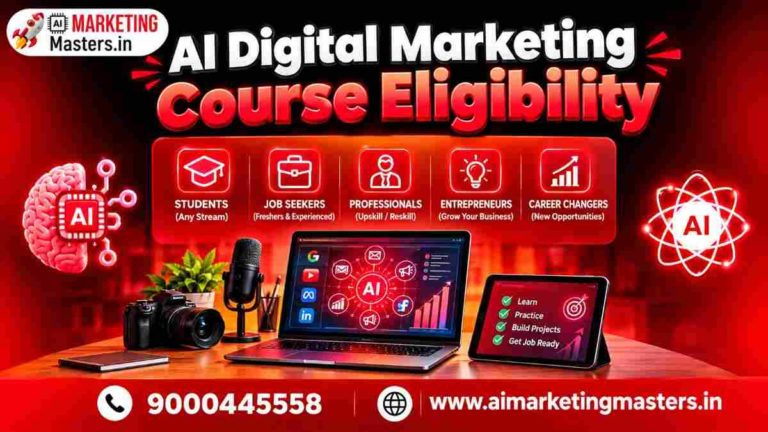
Eligibility for specific groups looks like this
- Students (currently studying or recently finished school/college) can typically join without any professional background.
- Graduates from any stream — engineering, commerce, arts, science — are commonly accepted.
- Working professionals from unrelated fields can usually join without needing to resign or pause their job, especially with weekend or evening formats.
- Career-gap candidates are generally welcome, though some institutes may ask about the learner’s goals to recommend the right course level.
- Entrepreneurs and business owners can join directly, often with the added benefit of applying lessons straight to their own business.
It’s worth being clear that eligibility requirements can differ meaningfully between institutes and between course formats (beginner vs. advanced, weekday vs. weekend, online vs. classroom). Always confirm specifics directly with the institute you’re considering rather than assuming one standard applies everywhere.
Educational Qualification Required for an AI Digital Marketing Course
Most training institutes set the baseline educational qualification at 10+2 (higher secondary school). This is a formal, administrative requirement rather than a reflection of the actual difficulty of the subject.
Here’s how it typically breaks down
- 10th qualification: Usually not sufficient on its own for structured, certificate-bearing programs, though some foundational or introductory modules may accept it.
- 12th qualification: The common minimum for most standard digital marketing and AI marketing courses.
- Diploma holders: Commonly accepted, regardless of the diploma’s subject area.
- Undergraduate degree: Not required, but graduates from any discipline can join without difficulty.
- Postgraduate degree: Not necessary either — postgraduates often join to add practical, tool-based skills to academic knowledge.
It helps to separate two different ideas: formal academic eligibility (the paperwork requirement to enroll) and practical readiness to learn digital marketing (whether you can actually absorb and apply the material). The second matters more for real outcomes. A learner with only a 12th-grade qualification but strong curiosity, consistency, and willingness to practice often outperforms someone with an advanced degree who treats the course passively. Institutes generally look for engagement and follow-through more than credentials.
Is a Degree Required for an AI Digital Marketing Course?
No, a degree is not required to join an AI digital marketing course. Most institutes accept learners with a 10+2 qualification, and both graduates and non-graduates can enroll and learn the same practical skills — from SEO and content marketing to AI-assisted campaign tools.
That said, a degree can still matter in specific situations
- Some corporate employers, particularly larger companies, list “graduate preferred” in job postings, even for entry-level marketing roles.
- Government or certain regulated-sector marketing roles may have formal degree requirements unrelated to the course itself.
- For freelancing, agency work, startups, or entrepreneurship, a degree is rarely a deciding factor — a strong portfolio and demonstrated results usually matter more.
In short: the training is open to non-graduates, but some employers may still apply their own degree preferences during hiring. It’s worth checking the requirements of the specific roles or companies you’re targeting rather than assuming either way.
Is Coding Required for AI Digital Marketing?
Coding is not required for most AI digital marketing courses. The vast majority of tools used in SEO, content marketing, social media, paid ads, and AI-assisted workflows are built with visual, no-code interfaces designed for marketers rather than developers.
Here’s how specific technical skills factor in
- HTML/CSS: A basic understanding can help with tasks like formatting blog posts or troubleshooting simple website issues, but it isn’t mandatory.
- JavaScript: Rarely needed, except for advanced technical SEO or certain analytics implementations, which are usually specialist tracks, not standard course content.
- Python: Useful for advanced marketing analytics or automation at a senior level, but not a beginner requirement.
- SQL: Occasionally useful for professionals working deeply with large datasets or in-house analytics teams, but not part of standard eligibility.
- General programming knowledge: Not expected of beginners.
While advanced programming isn’t required, basic technical understanding can be genuinely helpful — for example, knowing how a website’s backend loosely works can make technical SEO conversations easier, and comfort with spreadsheets can make analytics tasks faster. These are “nice to have,” not gatekeeping requirements.
Who Can Join an AI Digital Marketing Course?
AI digital marketing courses are designed to be accessible to a wide range of backgrounds. Here’s how different groups typically benefit
- Students: Get an early, practical skill set that can support internships, part-time freelance work, or a head start before entering the job market.
- Fresh graduates: Can build job-ready skills quickly, especially useful if their degree didn’t include marketing coursework.
- Working professionals: Can add a high-demand skill set to their existing experience, often useful for internal role changes or promotions.
- Career-switchers: Use the course as a structured way to pivot into marketing from an unrelated field.
- Career-gap candidates: Rebuild confidence and current, relevant skills before re-entering the workforce.
- Freelancers: Expand their service offerings (e.g., adding SEO or paid ads to existing content writing skills).
- Entrepreneurs and small business owners: Learn to run their own marketing instead of fully outsourcing it, saving costs and improving oversight.
- Website owners: Understand how to improve traffic, rankings, and conversions on their own sites.
- Traditional marketers: Update offline marketing experience with digital and AI-assisted skills.
- SEO professionals: Deepen expertise with AI-powered research and content tools.
- Social media professionals: Learn to integrate AI into content planning and performance tracking.
- Content writers: Add SEO, distribution, and AI-workflow skills around their existing writing ability — the dedicated AI Content Writing Course goes deeper into this specialization specifically.
Each group brings a different starting point, but the shared thread is that none of them require a pre-existing technical or marketing background to begin.
AI Digital Marketing Course Eligibility for Freshers
Freshers considering an AI digital marketing course should walk in with a few basics: comfort using a computer and smartphone, a stable internet connection, reasonable written and spoken communication skills, and — most importantly — a genuine willingness to learn and practice consistently.
There’s no need for prior marketing knowledge. Courses are typically structured to start from fundamentals (what SEO is, how social platforms work, how ads are structured) before introducing AI-assisted workflows on top of that foundation.
In terms of realistic career options, freshers who complete practical training and build a small portfolio of real or sample projects can look at entry-level roles such as Digital Marketing Executive, SEO Executive, Social Media Executive, or Content Marketing Executive. Outcomes depend heavily on how much practical work — not just watching lessons — a learner puts in during and after the course.
AI Digital Marketing Course Eligibility for Working Professionals
Working professionals from marketing, sales, IT, HR, business development, content, and customer support backgrounds are all reasonably well-positioned to pick up AI digital marketing skills, often faster than complete beginners, since they already understand business context, communication, or basic data handling.
- Marketing and sales professionals can add AI-assisted research, content, and campaign skills directly to their current role.
- IT professionals often adapt quickly to marketing tools and platforms due to general technical comfort.
- HR and business development professionals can apply digital marketing skills to employer branding, recruitment marketing, or partnership outreach.
- Content and customer support professionals already understand audience communication, which transfers well into content marketing and social media roles.
For most working professionals, the real question isn’t eligibility — it’s finding a course format (weekend, evening, or self-paced) that fits around a job.
AI Digital Marketing Course Eligibility for Career Gap Candidates
Candidates with a career gap — whether due to family responsibilities, health reasons, higher studies, or other circumstances — are generally welcome in AI digital marketing courses, and eligibility requirements don’t differ meaningfully from other learners.
What matters more at this stage is a practical re-entry plan
- Skill development: Focus on core skills first (SEO, content, social media, basic ads) before adding advanced AI workflows.
- Portfolio building: Create sample campaigns, blog posts, or mock social calendars to demonstrate current ability, since a resume gap alone doesn’t show skill.
- Practical projects: Volunteer to manage a small business’s or friend’s social media page as a real-world exercise.
- Certifications: Course completion certificates and free certifications (from platforms like Google Skillshop or HubSpot Academy) can help demonstrate updated knowledge.
- Freelancing: Small freelance projects can rebuild both confidence and a visible track record.
- Internships: Short internships, even unpaid or low-cost ones, can bridge the gap on a resume.
- Demonstrating current knowledge: Actively showing familiarity with current AI tools can offset concerns about being “out of touch.”
It’s important to be realistic here: a course or certificate alone does not guarantee re-employment. Consistent, visible practical work after training tends to matter more than the certificate itself.
Skills Required Before Joining an AI Digital Marketing Course
Before enrolling, it helps to distinguish between skills that are genuinely required and skills that are simply recommended.
Required (baseline) skills:
- Basic computer knowledge (opening apps, saving files, using a browser)
- Comfort with internet browsing and using search engines
- Basic written and spoken communication skills
Recommended (helpful, not mandatory) skills:
- Content writing fundamentals
- Familiarity with social media platforms as a user
- Analytical thinking (being comfortable looking at numbers and drawing basic conclusions)
- Creativity, especially for content and campaign ideas
- Willingness to experiment with new tools rather than sticking to one method
- Basic understanding of how websites work (pages, links, navigation)
None of the recommended skills are prerequisites — they’re simply things that make the learning curve smoother. Institutes generally expect to teach these from the ground up.
What Will You Learn in an AI Digital Marketing Course?
A well-structured AI digital marketing course typically covers
- SEO fundamentals, AI-powered SEO research, and increasingly Generative Engine Optimization (GEO)
- Keyword research and search intent analysis
- Content marketing and AI-assisted content workflows
- Google Business Profile optimization for local visibility
- Social media marketing, including AI-assisted content planning
- PPC and paid advertising (Google Ads, Meta Ads)
- Email marketing and marketing automation basics
- Web analytics and performance tracking
- Conversion rate optimization
- Lead generation strategies
- Practical use of AI tools for marketers
- Prompt engineering for marketing tasks
- Generative AI for content and creative ideation
- Chatbots and conversational marketing basics
- Customer and competitor research
- Marketing reporting and dashboards
The exact depth of each topic varies by institute and course level, so it’s worth reviewing a detailed syllabus before enrolling.
AI Tools Used in Digital Marketing
Modern marketers commonly use AI-powered platforms to support (not replace) their work across
- Content ideation: Generating topic ideas and outlines faster.
- Keyword research: Surfacing search patterns and content gaps.
- Content optimization: Improving readability, structure, and on-page SEO elements.
- Image and video creation: Producing draft visuals with AI image or AI video tools for testing.
- Social media management: Scheduling, caption assistance, and basic performance summaries.
- Data analysis: Summarizing analytics data into digestible insights.
- Email campaigns: Assisting with subject lines and audience segmentation.
- Marketing automation: Triggering repetitive workflows based on user behavior.
- Customer support: Handling common queries through chatbots.
- Competitor research: Speeding up the process of gathering public competitor data.
It’s important to be clear that AI tools do not replace human strategy, brand judgment, editing, fact-checking, or final decision-making. They speed up specific tasks, but marketers remain responsible for accuracy, tone, and results.
Career Opportunities After an AI Digital Marketing Course
After building practical skills, learners can realistically consider roles such as
- Digital Marketing Executive — handles day-to-day campaign and content tasks
- SEO Executive / AI SEO Specialist — focuses on organic search visibility, increasingly using AI-assisted research
- Content Marketing Executive / Content Strategist — plans and produces content across channels
- Social Media Specialist — manages brand presence and engagement on social platforms
- PPC Executive / Performance Marketing Specialist — runs and optimizes paid ad campaigns
- Email Marketing Specialist — manages email campaigns and segmentation
- Marketing Automation Specialist — builds and maintains automated marketing workflows
- Digital Marketing Analyst — interprets campaign and website performance data
- AI Marketing Specialist — focuses specifically on integrating AI tools into marketing operations
- Growth Marketing Executive — works across channels to drive measurable growth
- Freelance Digital Marketer — manages independent client projects across one or more specializations
Actual job titles, responsibilities, and seniority levels vary significantly by company size and industry. For a closer, role-by-role look at responsibilities and typical hiring patterns, see this breakdown of AI-powered digital marketing jobs. Learners drawn specifically to the visual side of these roles can also explore the AI Graphic Design Course as a specialization.
AI Digital Marketing Jobs in India
India’s employment landscape for digital marketing continues to expand, supported by a fast-growing internet user base and rising AI adoption. According to the Internet in India Report 2025 (IAMAI–Kantar), India crossed 958 million active internet users in 2025, with rural India now accounting for the majority (around 57%) of active users, and roughly 44% of users already engaging with AI-enabled features such as voice search, chatbots, and AI filters — usage that skews notably higher among the 15–24 age group.
This growing digital base is driving demand for marketing talent across several sectors, with industry bodies such as NASSCOM regularly tracking hiring trends across India’s technology and IT services ecosystem
- Startups and D2C brands (which rely heavily on digital-first customer acquisition)
- E-commerce and quick commerce platforms
- SaaS companies (India and global-facing)
- IT services firms with marketing teams
- EdTech platforms
- Healthcare and wellness brands
- Real estate developers and portals
- Financial services and fintech companies
- Retail chains building online presence
- Digital and performance marketing agencies
- Local and regional businesses expanding online
As search behavior shifts toward AI-powered results, chatbots, and voice queries, employers are increasingly looking for marketers who understand both traditional digital marketing and how to work with AI-driven platforms — rather than treating these as separate skill sets.
AI Digital Marketing Salary in India
Salary depends heavily on role, city, specialization, and how well you can apply AI and automation tools — broadly, freshers start in the ₹2.5–5 LPA range, mid-level professionals move into ₹6–12 LPA, and senior strategists or managers can reach ₹20 LPA and beyond, though these are directional figures, not guarantees. For a full experience-wise breakdown by role and the specific AI skills that push pay higher, see the AI Digital Marketing Salary in India guide.
AI Digital Marketing Career Path
Progression typically runs from a beginner executive role through intermediate specialization (SEO, PPC, analytics), to advanced campaign ownership, and eventually strategy or leadership positions — with consistent practical experience mattering more than time spent at any single stage. The AI Digital Marketing Syllabus maps out exactly which skills and tools correspond to each stage of that progression.
AI Digital Marketing Course Certification
A course completion certificate typically represents that a learner has finished a defined curriculum and completed associated assessments or projects at a given institute. It’s useful as a record of structured learning, but it’s worth understanding its limits.
- Course certificate vs. industry-recognized certification: A course completion certificate from a training institute differs from third-party industry certifications (such as Meta Blueprint or Google Skillshop credentials), which carry independent recognition.
- Why practical projects matter: Employers and clients generally respond more to demonstrated work — a sample SEO audit, a mock campaign, a portfolio site — than to a certificate alone.
- Why portfolios strengthen applications: A portfolio shows applied skill, not just completed coursework.
- How certifications complement experience: Certifications work best when paired with real practice, not as a standalone credential.
An AI Digital Marketing Certification, whether from an institute or an industry platform, is most valuable when it’s backed by actual project work a candidate can speak to in interviews. A certificate alone does not guarantee employment.
Why AI Digital Marketing is One of the Best IT and Marketing Careers in India
Several factors make this a genuinely promising — though not risk-free — career path in India right now
- Rapidly growing digital adoption, with internet penetration continuing to rise across both urban and rural India
- Increasing AI adoption among everyday internet users, creating demand for marketers who understand AI-assisted tools
- Rising online competition, pushing businesses to invest more in measurable digital marketing
- Growth of e-commerce, D2C, and SaaS sectors, all of which rely heavily on digital channels
- Remote and freelance opportunities, which are more accessible in marketing than in many other fields
- Multiple specialization paths (SEO, paid ads, content, analytics, automation), allowing career flexibility
- Openness to career switchers, since many employers prioritize demonstrated skill over formal marketing degrees
- Scope for entrepreneurship, since marketing skills directly support running one’s own business
That said, the field also comes with real challenges: marketing platforms, algorithms, and AI tools change frequently, which means continuous learning isn’t optional — it’s part of the job. Professionals who stop updating their skills can fall behind relatively quickly in this field.
AI Digital Marketing vs Traditional Digital Marketing
Factor | Traditional Digital Marketing | AI Digital Marketing |
Research | Manual + basic tools | AI-assisted + human analysis |
Content | Primarily manual creation | AI-assisted drafting + human editing |
Data Analysis | Traditional analytics dashboards | AI-assisted pattern recognition |
Automation | Limited to moderate | Greater automation possibilities |
Personalization | Rule-based segmentation | AI-assisted personalization |
Productivity | Fully human-driven | Combined human + AI workflow |
Strategy | Based on human expertise | Human expertise supported by AI insights |
The core takeaway: AI enhances marketing execution and speed, but it doesn’t eliminate the need for human judgment, brand understanding, or strategic decision-making.
AI Digital Marketing Course Eligibility vs Other Career Paths
Factor | AI Digital Marketing | SEO (Standalone) | Data Analytics | Software Development | Business Analytics |
Entry Requirement | 10+2, no degree needed | 10+2, no degree needed | Often prefers a degree | Often prefers a technical degree | Often prefers a degree |
Coding Requirement | Generally not required | Generally not required | Basic to moderate (SQL, Excel) | Required (multiple languages) | Basic to moderate |
Creativity | High (content, campaigns) | Moderate | Low to moderate | Low | Moderate |
Analytics Focus | Moderate | Moderate | High | Low to moderate | High |
Career Focus | Marketing execution + strategy | Organic search growth | Data-driven decision-making | Building software products | Business decision support |
Typical Learner Profile | Broad — students, graduates, professionals, business owners | Marketers, content professionals | Numerically inclined learners | Technically inclined learners | Business/commerce-oriented learners |
This comparison is meant to help you see where AI digital marketing sits relative to adjacent fields — not to suggest one path is universally better than another. The right choice depends on your interests and strengths.
How to Choose the Right AI Digital Marketing Course
Before enrolling anywhere, it’s worth evaluating a course against these criteria
- Curriculum depth: Does it cover SEO, content, social, paid ads, analytics, and AI tools in reasonable depth — not just a surface overview?
- Trainer experience: Do trainers have real, verifiable industry experience?
- Practical projects: Will you work on real or realistic campaigns, not just watch recorded lessons?
- Live campaign exposure: Does the course include any hands-on work with live ad accounts or real websites?
- AI tools covered: Are current, relevant AI tools actually taught, not just mentioned?
- SEO and PPC training depth: Are these covered thoroughly, since they remain core to most marketing roles?
- Analytics training: Is there dedicated time on reading and interpreting data?
- Certification: Is there a clear, recognized certificate on completion?
- Internship opportunities: Does the institute offer or help arrange internships?
- Placement assistance: What exactly does “placement assistance” include — is it guaranteed interviews, resume support, or simply a job board?
- Course duration and format: Does the timing (weekday, weekend, online, or classroom) fit your schedule?
- Reviews and reputation: What do independent, verifiable reviews say?
- Post-course support: Is there any support after the course ends, such as doubt-clearing or community access?
It’s worth independently verifying specific claims — such as placement percentages or salary promises — directly with current or former students rather than relying solely on marketing material.
How to Start Learning AI Digital Marketing
A practical, step-by-step approach looks like this
- Learn digital marketing fundamentals (channels, terminology, how campaigns work)
- Understand SEO basics (keywords, on-page, off-page, technical SEO)
- Learn content and social media marketing
- Learn paid advertising basics (Google Ads, Meta Ads)
- Learn how to read and use analytics
- Learn useful AI tools relevant to marketing tasks
- Practice prompt-based marketing workflows
- Build real or sample projects to apply what you’ve learned
- Create a portfolio showcasing your work
- Apply for internships, entry-level jobs, freelance projects, or start applying skills to your own business
- Keep updating your skills, since both AI tools and marketing platforms evolve quickly
This sequence works whether you’re learning through a structured course, self-study, or a mix of both.
Future Scope of AI Digital Marketing in India
Several trends are shaping where digital marketing is headed, though it’s worth noting that no single technology is guaranteed to dominate — the landscape continues to shift
- AI-powered search experiences and AI-generated search summaries becoming more common
- Growing importance of Generative Engine Optimization (GEO) and Answer Engine Optimization (AEO)
- Increasing relevance of LLM-based content discovery
- More automated campaign optimization across ad platforms
- Predictive analytics becoming more accessible to smaller businesses
- Greater personalization in marketing messaging
- Growth of conversational marketing through chatbots and messaging apps
- AI-assisted creative workflows for content and design
- Continued expansion of marketing automation
- Increasing focus on first-party data as third-party tracking becomes more limited
- Ongoing emphasis on customer journey optimization across channels
Marketers who stay current with these shifts — without assuming any single trend is permanent — tend to remain more adaptable and employable over time.
Key Takeaways
- Eligibility is accessible: Most AI digital marketing courses require only a 10+2 qualification, with no strict age or stream restrictions.
- A degree is not mandatory, though some employers may still prefer one for specific roles — training and hiring preferences are separate things.
- Coding is not required for most courses; basic computer and internet familiarity is enough to begin.
- Career opportunities span multiple roles — from SEO and content to paid ads, analytics, and AI-specific marketing positions — across a wide range of industries in India.
- Practical skills and portfolios matter more than credentials alone; consistent hands-on practice is what actually drives real-world results.
Conclusion
So, what does AI Digital Marketing Course Eligibility really come down to? In most cases, very little stands between you and getting started: a 10+2 qualification, basic computer and internet comfort, and a genuine interest in learning are typically enough. Students, graduates from any stream, working professionals looking to pivot or upskill, freelancers, entrepreneurs, and even candidates returning after a career gap can all reasonably join — advanced technical knowledge or coding is generally not required for most beginner-level programs.
What matters more than meeting the minimum eligibility bar is what you do with the training afterward. Practical, hands-on learning — building real projects, experimenting with AI tools, and creating a portfolio you can actually show — tends to matter far more to employers and clients than the certificate alone. And because both AI tools and marketing platforms continue to evolve, treating this as a field for continuous learning, not a one-time course, will serve you better in the long run.
If this sounds like a field you’re ready to explore, the most useful next step isn’t just reading about eligibility — it’s starting to build. Pick one small project, try a free AI marketing tool, or outline your first mock campaign, and take it from there. If you’d prefer structured, mentor-led training instead of self-study, you can check batch dates, fees, and curriculum on the Digital Marketing with AI Course in Hyderabad page, or chat with the team on WhatsApp for a free demo session.
FAQ
- What is the eligibility for an AI digital marketing course?
Most institutes require a 10+2 qualification, basic computer and internet familiarity, and an interest in marketing. A specific stream, degree, or technical background is generally not required.
- Can I join an AI digital marketing course after 12th?
Yes. Completing 12th grade meets the minimum eligibility bar at most institutes, and many students join directly after finishing school.
- Is graduation necessary for an AI digital marketing course?
No, graduation is not necessary. Both graduates and non-graduates can enroll and learn the same core skills, though some employers may separately prefer a degree for certain job roles.
- Is coding required to learn AI digital marketing?
No. Most AI digital marketing tools use no-code, visual interfaces. Basic technical understanding can help in some situations, but programming knowledge is not a standard requirement.
- Can freshers learn AI digital marketing?
Yes. Courses are typically designed to start from fundamentals, so freshers with no prior marketing background can learn effectively with consistent practice.
- Can working professionals join an AI digital marketing course?
Yes. Professionals from marketing, sales, IT, HR, and other fields commonly join, often choosing weekend or evening formats to fit around their jobs.
- Can career-gap candidates learn AI digital marketing?
Yes. Career-gap candidates are generally welcome, and pairing the course with practical projects or freelance work can help rebuild a current, demonstrable skill set.
- What skills are required for AI digital marketing?
Basic computer and internet skills are required. Skills like content writing, analytical thinking, and creativity are helpful but are typically taught during the course rather than expected beforehand.
- What jobs can I get after completing an AI digital marketing course?
Common entry points include Digital Marketing Executive, SEO Executive, Content Marketing Executive, and Social Media Executive, with progression toward analyst, specialist, or management roles over time.
- Is AI digital marketing a good career in India?
It’s a growing field supported by rising internet and AI adoption in India, offering multiple specialization paths and freelance flexibility — though it also requires continuous learning as tools and platforms keep evolving.

AI Marketing Trainer
AI Marketing Masters Editorial Team |
Ambica brings over 8+ years of hands on experience in the digital marketing industry, having worked closely with startups and small businesses to boost their online presence through effective, performance driven strategies.
Share