
SEO vs GEO (Generative Engine Optimization)
1. Introduction: SEO vs GEO in the Age of AI
When we think about online visibility, the first thing that comes to mind is SEO (Search Engine Optimization). For the last two decades, SEO has helped businesses, brands, and individuals reach audiences through search engines like Google, Bing, and Yahoo.
But in 2025, the digital marketing world is shifting rapidly. A new form of optimization has entered the scene GEO (Generative Engine Optimization).
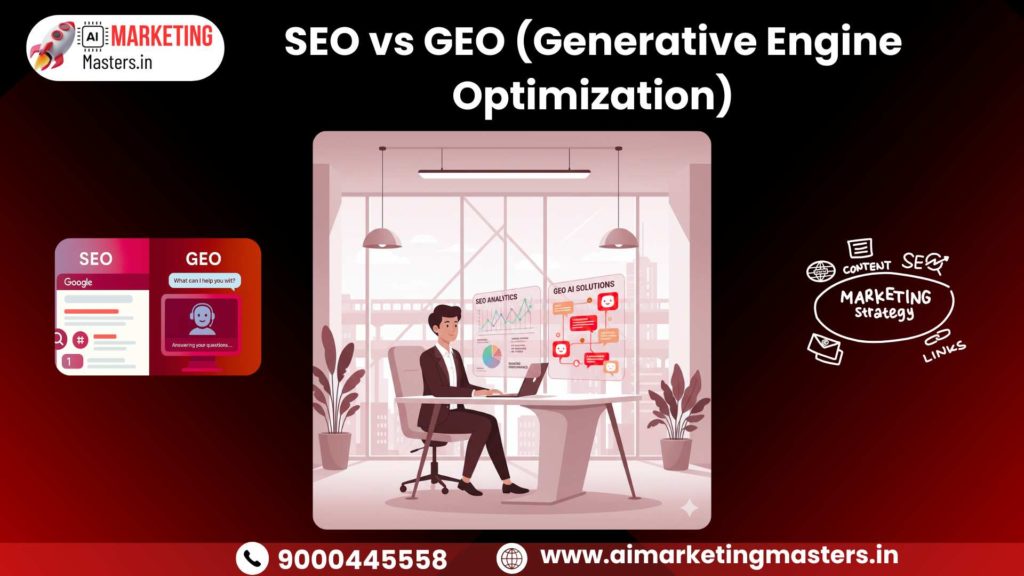
So, what exactly is GEO, and how is it different from SEO? While SEO focuses on ranking your website on search engines, GEO focuses on getting your brand discovered in AI-powered answer engines like ChatGPT, Perplexity, Gemini, Claude, and even AI assistants on phones and smart devices.
This blog will give you a complete comparison between SEO and GEO. You’ll learn:
- What SEO really means in today’s world.
- Why GEO is becoming the next big thing in digital marketing.
- How SEO and GEO differ in approach and execution.
- The advantages, challenges, and future of both.
- A step-by-step action plan to adopt both SEO and GEO for your business.
If you are a business owner, marketer, or student looking for Digital Marketing with AI strategies, this blog will help you future proof your content marketing approach. Let’s dive in!
2. What is SEO? (Traditional Search Engine Optimization)
SEO (Search Engine Optimization) is the process of improving your website so it ranks higher in search results for relevant keywords. The higher you rank, the more traffic, leads, and sales you can generate.
Key Elements of SEO
- On-Page SEO
- Optimizing titles, meta descriptions, and headers.
- Using the right keywords and clusters naturally.
- Adding internal and external links.
- Writing high-quality, user-friendly content.
- Off-Page SEO
- Building backlinks from trusted websites.
- Social sharing and brand mentions.
- Guest blogging and PR-based link building.
- Technical SEO
- Site speed optimization.
- Mobile responsiveness.
- Clean URL structures.
- Schema markup for better indexing.
- Content SEO
- Writing blogs, guides, FAQs, and case studies.
- Using semantic keywords (LSI).
- Including multimedia like images, videos, and infographics.
Why SEO Still Matters
- Search engines like Google handle 8.5 billion searches daily.
- 70% of traffic goes to the first 5 results.
- Businesses with strong SEO save money on paid ads.
Cluster Keywords to Include: SEO training, SEO tools, digital marketing SEO, technical SEO, on-page SEO, SEO in Hyderabad, SEO strategies.
In short, SEO is well-established and still the backbone of digital visibility but it’s evolving.
3. What is GEO? (Generative Engine Optimization)
Generative Engine Optimization (GEO) is the new frontier of digital marketing. Instead of optimizing for Google’s search results, you optimize for AI-driven answer engines. These include ChatGPT, Gemini, Perplexity, and other AI assistants that provide direct answers rather than showing a list of links.
How GEO Works
- AI Engines Instead of Search Engines
- Users don’t type “best digital marketing course in Hyderabad” into Google.
- Instead, they ask ChatGPT: “Which is the best digital marketing course in Hyderabad with AI training?”
- The AI pulls from trusted sources, knowledge graphs, and optimized content.
- Focus on Conversational Content
- GEO requires writing natural, conversational answers.
- FAQs, Q&A-style blogs, and structured content perform better.
- Entity + Semantic Optimization
- AI relies on entities, knowledge graphs, and semantic signals.
- You need structured data and contextual relevance, not just keywords.
Why GEO is Different
- GEO = Optimizing for AI answers, not rankings.
- GEO = Making your brand discoverable in generative search.
- GEO = The future of digital marketing with AI.
Cluster Keywords: Generative Engine Optimization, GEO marketing, AI SEO strategy, conversational search, generative AI in marketing, answer engine optimization.
If SEO was about ranking pages, GEO is about owning answers.
4. Key Differences Between SEO and GEO
To understand SEO vs GEO, let’s compare them point by point:
1. Search Engine vs Answer Engine
- SEO: Targets Google, Bing, and Yahoo.
- GEO: Targets ChatGPT, Gemini, Perplexity, and AI tools.
2. Ranking vs Answering
- SEO: Focuses on ranking a page higher in results.
- GEO: Focuses on being the trusted answer AI provides.
3. Keywords vs Entities
- SEO: Relies heavily on keywords and backlinks.
- GEO: Relies more on entities, structured data, and conversational context.
4. User Behavior
- SEO: Users scroll through results and click links.
- GEO: Users expect direct, summarized answers.
5. Measurement
- SEO: Tracks clicks, impressions, rankings.
- GEO: Tracks mentions in AI responses, authority, and AI citations.
SEO vs GEO Table Example
|
Feature |
SEO |
GEO (Generative Engine Optimization) |
|
Target |
Search Engines |
AI Answer Engines |
|
Goal |
Higher Rankings |
AI Mentions / Answers |
|
Content Style |
Keyword-rich |
Conversational + Semantic |
|
Data Focus |
Backlinks + Keywords |
Entities + Knowledge Graphs |
|
User Experience |
Click-through |
Direct answers |
This comparison shows that SEO is not dead, but GEO is the next layer of optimization you can’t ignore.
5. Why GEO is Emerging in 2025
The rise of Generative Engine Optimization (GEO) is not a coincidence. It’s happening because user behavior is changing and AI-driven platforms are becoming the first choice for information. Let’s break this down:
1. Rise of AI Search Engines
- Platforms like ChatGPT, Perplexity, and Gemini are slowly replacing Google for quick answers.
- Instead of scrolling through 10 links, users ask one question and get an instant answer.
- This creates a huge opportunity for businesses to appear in AI answers instead of just Google’s results.
2. User Behavior Shift
- Today’s users, especially Gen Z and professionals, don’t want to waste time searching.
- They ask AI tools: “Which is the best stock market course in Hyderabad?” instead of browsing 5 websites.
- This means GEO is directly tied to conversational search and intent-based answers.
3. Decrease in Traditional Clicks
- Google’s zero-click searches are already high (more than 60% in some niches).
- With AI assistants, this percentage will only grow because answers are given inside AI platforms without clicks.
4. Early Adopter Advantage
- Just like SEO gave early adopters a big traffic boost, GEO will reward those who optimize now.
- Businesses that start creating AI-friendly, entity-driven content in 2025 will become future leaders.
Cluster Keywords: Generative AI marketing, GEO strategy, AI-driven search, conversational SEO, future of digital marketing with AI.
In simple words: GEO is emerging because people want answers, not just links.
6. Similarities Between SEO and GEO
While SEO and GEO are different in execution, they share some common ground. Let’s look at the similarities point by point:
1. Visibility is the Goal
- Both SEO and GEO aim to make your brand visible online.
- Whether it’s Google or ChatGPT, the end goal is attracting customers.
2. Content is Still King
- SEO: Long-form blogs, guides, and keyword-optimized content.
- GEO: Conversational, FAQ-based, and entity-driven content.
- In both, content quality matters more than quantity.
3. Authority Matters
- SEO uses backlinks and domain authority.
- GEO uses trust signals, brand mentions, and knowledge graph connections.
- Both need credibility to rank or appear in answers.
4. Continuous Updates
- SEO needs regular updates due to algorithm changes.
- GEO needs regular monitoring as AI engines update frequently.
- Both demand ongoing optimization, not a one-time effort.
5. Structured Data Helps Both
- Schema markup, knowledge graphs, and clear formatting help in both SEO and GEO.
- Structured content makes it easier for both search engines and AI engines to understand your website.
Cluster Keywords: SEO and GEO together, AI optimization, content visibility, brand authority in AI search, structured SEO.
In short: SEO and GEO may look different, but they share the same DNA content + trust + visibility.
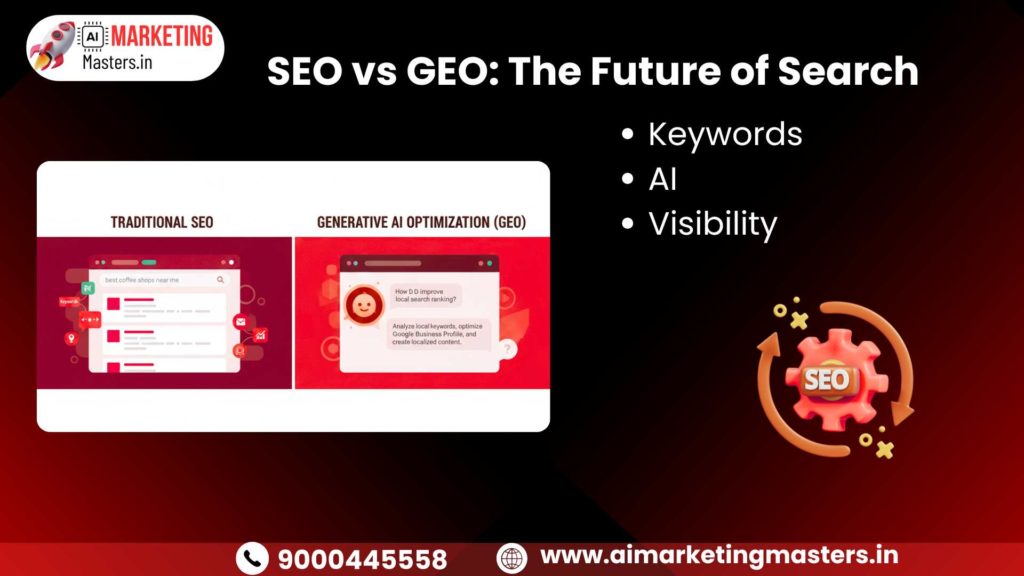
7. Advantages of SEO
Even in 2025, SEO remains powerful. Here are the key advantages:
1. Proven Traffic Source
- Google search still drives the largest share of organic traffic globally.
- For many businesses, SEO is their primary source of leads.
2. Cost-Effective
- Unlike ads, SEO brings long-term results.
- Once a blog ranks, it can bring traffic for years.
3. Established Tools & Strategies
- SEO is a mature industry with tools like SEMrush, Ahrefs, and Google Search Console.
- You can measure performance with clarity.
4. Builds Trust & Authority
- Ranking high in Google means people trust your brand.
- SEO-backed content positions you as an expert.
5. Works for All Niches
- From e-commerce to healthcare, SEO is relevant everywhere.
- Even local businesses benefit through Local SEO optimization.
Cluster Keywords: SEO benefits, advantages of SEO, long-term SEO strategy, cost-effective digital marketing, organic SEO traffic.
So, SEO remains a stable and reliable foundation for digital marketing in 2025.
8. Advantages of GEO
Now let’s look at why GEO (Generative Engine Optimization) is becoming equally important:
1. Early Mover Advantage
- GEO is new, so competition is low.
- Brands that optimize now will dominate AI answers in the next few years.
2. AI-Powered Visibility
- Instead of competing for 10 spots on Google, GEO gets you directly into AI-generated responses.
- This is powerful for brand awareness.
3. Conversational Marketing
- GEO requires natural, conversational content, which connects better with audiences.
- This means higher engagement and trust.
4. Future-Ready Strategy
- AI-powered search is only going to grow.
- GEO ensures you’re not left behind when AI engines become the norm.
5. Works Hand-in-Hand with SEO
- GEO doesn’t replace SEO, it adds another layer.
- Together, they create 360-degree visibility across both search engines and AI platforms.
Cluster Keywords: GEO benefits, advantages of generative engine optimization, AI search visibility, conversational GEO strategy, GEO vs SEO.
Simply put: GEO gives you a first-class ticket into the future of digital marketing.
9. Challenges of SEO in 2025
Even though SEO is powerful, it comes with its own challenges. Marketers in 2025 need to be aware of these limitations:
1. Constant Algorithm Updates
- Google updates its algorithm several times a year.
- What worked in 2022 may no longer be effective in 2025.
- Marketers must adapt quickly to maintain rankings.
2. High Competition
- Every business invests in SEO.
- Competing with big brands with higher budgets is tough.
- Ranking for competitive keywords takes time and resources.
3. Zero-Click Searches
- Google often provides direct answers (featured snippets, knowledge panels).
- This reduces clicks to websites even when they rank.
- Marketers must optimize for visibility, not just clicks.
4. Long ROI Timeline
- SEO takes 3–6 months (sometimes more) to show results.
- Businesses looking for quick results may get frustrated.
5. Cost of Quality SEO
- While SEO is cheaper than ads long-term, quality SEO is not free.
- You need investment in content, tools, and backlinks.
Cluster Keywords: SEO challenges, SEO problems 2025, zero-click searches, SEO competition, SEO updates.
In short: SEO works, but it requires patience, consistency, and adaptability.
10. Challenges of GEO
Since GEO is new, it also brings unique challenges that marketers need to overcome:
1. Lack of Awareness
- Most businesses don’t know what GEO is yet.
- This means fewer resources and case studies are available.
2. No Standard Framework
- SEO has established tools like Ahrefs and SEMrush.
- GEO has no fixed playbook yet, making it experimental.
3. Dependence on AI Engines
- GEO relies on platforms like ChatGPT, Gemini, and Perplexity.
- If they change how they show answers, strategies may break.
4. Hard to Measure Success
- In SEO, you track rankings and clicks.
- In GEO, measuring “AI mentions” or “answer visibility” is tricky.
5. Content Adaptation Costs
- Creating conversational, entity-based content requires more effort.
- Businesses must invest in training teams for GEO.
Cluster Keywords: GEO challenges, generative AI problems, GEO limitations, answer engine optimization issues, GEO in digital marketing.
So, while GEO is exciting, it’s also unpredictable. marketers must treat it as a long-term investment.
11. SEO Strategies for 2025
To stay relevant, here are the top SEO strategies for 2025:
1. Entity SEO
- Move beyond keywords.
- Focus on entities, people, places, and brands that Google understands.
2. Semantic Keywords
- Use related terms and LSI keywords to build context.
- Example: Instead of just “SEO course in Hyderabad,” add “digital marketing SEO training,” “learn SEO with AI,” etc.
3. Core Web Vitals
- Google prioritizes fast, mobile-friendly websites.
- Optimize loading speed, interactivity, and stability.
4. Voice & Video SEO
- With smart speakers, voice search is rising.
- YouTube SEO is also critical because video search results dominate Google.
5. Content Refresh
- Update old blogs with new data, FAQs, and AI-driven insights.
- Freshness is a key ranking factor.
Cluster Keywords: SEO strategies 2025, entity SEO, semantic SEO, voice SEO, SEO updates, SEO training Hyderabad.
In short: SEO in 2025 is about being smarter, faster, and more relevant.
12. GEO Strategies for 2025
Here’s how you can optimize for GEO and get featured in AI answers:
1. Conversational Content
- Write in a Q&A style.
- Example: Instead of long paragraphs, use clear answers to specific queries.
2. Structured Data + Schema
- AI engines pull answers from structured content.
- Use schema markup, tables, bullet points, and lists.
3. FAQs & Answer Hubs
- Create FAQ sections targeting conversational queries.
- Example: “What is GEO?” “How is GEO different from SEO?”
4. Knowledge Graph Building
- Ensure your business/brand is connected in Google Knowledge Graphs, Wikidata, LinkedIn, Crunchbase.
- AI engines prefer brands with entity authority.
5. Authority Signals
- GEO relies on trust.
- Get cited in industry publications, blogs, and AI datasets.
Cluster Keywords: GEO strategies 2025, generative SEO optimization, answer engine marketing, conversational GEO content, AI-driven GEO.
So, GEO is less about keywords and more about making your brand answer-ready.

13. SEO vs GEO: Which is Better for Businesses?
This is the big question: should businesses choose SEO or GEO?
When SEO Works Better
- Local businesses (restaurants, clinics, small shops).
- E-commerce websites.
- Businesses targeting Google Maps and local search.
When GEO Works Better
- AI-focused industries (tech, SaaS, digital marketing).
- Knowledge-based businesses (education, consulting).
- Brands targeting thought leadership visibility.
Best Approach: SEO + GEO Together
- SEO gives stable traffic from search engines.
- GEO gives early exposure in AI engines.
- Together, they create a future-proof strategy.
Cluster Keywords: SEO vs GEO, SEO or GEO which is better, SEO and AI marketing, best strategy SEO + GEO.
So, don’t choose one combine both for maximum results.
14. Future of SEO and GEO Together
Looking ahead, here’s how SEO and GEO will work together:
1. Hybrid Search
- Future search will mix Google results + AI answers.
- Example: Google already integrates AI overviews.
2. Content Must Serve Both
- Blogs must rank on Google and appear in AI answers.
That means writing optimized conversational content.
3. Rise of AI-First Platforms
- Platforms like Perplexity are gaining traction.
- Businesses need GEO to stay relevant beyond Google.
4. Marketers with Dual Skills Win
- Professionals skilled in SEO + GEO will be in demand.
- Companies will prefer agencies offering both.
Cluster Keywords: future of SEO and GEO, hybrid search, AI overviews Google, GEO future strategy.
The future is not SEO vs GEO, but SEO + GEO working together.
15. Action Plan: How to Adapt SEO and GEO for Your Business
Here’s a step-by-step action plan you can follow:
Step 1: Strengthen SEO Basics
- Optimize your site speed, on-page SEO, and mobile experience.
- Keep building backlinks.
Step 2: Start GEO Content
- Add FAQ sections, conversational blogs, and entity-rich content.
- Use AI tools to test if your brand appears in ChatGPT/Gemini answers.
Step 3: Build Authority
- Get listed in directories, publications, and knowledge graphs.
- Focus on brand mentions instead of just backlinks.
Step 4: Measure Both
- Track rankings (SEO) + AI mentions (GEO).
- Use surveys to ask: “Did you find us through Google or ChatGPT?”
Step 5: Iterate
- Keep updating both SEO and GEO strategies.
- Test new AI platforms regularly.
Cluster Keywords: SEO and GEO action plan, business SEO GEO strategy, GEO roadmap, SEO + GEO implementation.
By following this roadmap, you’ll future-proof your brand visibility.
16. Conclusion
SEO has been the backbone of digital marketing for years, and it’s not going away. But with the rise of Generative Engine Optimization (GEO), businesses must expand their strategies.
- SEO ensures visibility on Google.
- GEO ensures visibility in AI answers.
- Together, they create complete online dominance.
If you’re in Hyderabad (or anywhere in the world) and want to master Digital Marketing with AI, learning SEO + GEO together is the smartest move for 2025.
Final Tip: Don’t see SEO and GEO as competitors. See them as partners in growth. The earlier you adopt GEO along with SEO, the bigger your advantage.

FAQs
1. What is SEO?
SEO (Search Engine Optimization) is the process of improving a website so it ranks higher on search engines like Google. It includes on-page SEO, off-page SEO, and technical SEO. The goal is to bring organic traffic, generate leads, and build online visibility.
2. What is GEO in digital marketing?
GEO stands for Generative Engine Optimization. It focuses on optimizing content so that AI tools like ChatGPT, Perplexity, and Gemini show your brand in their answers. Instead of just ranking in Google, you make your content AI-answer friendly.
3. How is SEO different from GEO?
- SEO works for search engines like Google and Bing.
- GEO works for generative AI engines like ChatGPT and Gemini.
SEO depends on keywords and backlinks, while GEO depends on entities, structured data, and conversational content.
4. Why is GEO important in 2025?
In 2025, people are shifting from traditional Google searches to AI assistants for answers. GEO ensures that your business appears in those AI-powered answers, giving you visibility where users are actually searching.
5. Can SEO and GEO work together?
Yes! SEO gives long-term rankings in Google, and GEO gives visibility in AI answers. Together, they create a complete strategy for businesses to reach more people.
6. Which is better: SEO or GEO?
Neither is “better.” SEO is established and proven, while GEO is new and fast-growing. Businesses that use both will have the biggest advantage in digital marketing.
7. What are the main strategies for SEO in 2025?
- Focus on entity SEO (brands, people, places).
- Use semantic keywords instead of just exact matches.
- Optimize for voice and video search.
- Improve Core Web Vitals for speed and mobile experience
- Refresh old blogs with updated content and FAQs.
8. What are the main strategies for GEO?
- Write conversational content in Q&A format.
- Add FAQs and structured data.
- Build knowledge graph authority (Wikipedia, LinkedIn, Crunchbase).
- Focus on brand mentions in AI training sources
- Create AI-friendly content hubs around topics.
9. How do I know if my content is optimized for GEO?
You can test by asking AI tools like ChatGPT, Gemini, or Perplexity questions in your niche. If your brand or blog is mentioned, you’re doing GEO right. If not, you need more entity optimization and structured content.
10. Will SEO die because of GEO?
No. SEO will continue to be important because billions of people still use Google daily. GEO will add another layer of visibility. Think of GEO as an evolution of SEO, not a replacement.
11. How can small businesses use GEO?
Small businesses can:
- Write blogs in conversational style.
- Add FAQ sections on their websites.
- Get listed in local directories and knowledge bases.
Use AI tools to check if they appear in answers.
12. How do search engines and answer engines differ?
- Search engines (Google) show a list of results.
- Answer engines (ChatGPT, Perplexity) give direct answers.
- With SEO you want clicks, with GEO you want answer visibility.
13. What tools can I use for GEO?
Currently, GEO doesn’t have fixed tools like SEO. But you can use:
- Google Knowledge Graph Explorer
- Schema markup generators
- AI search testing (ChatGPT, Gemini, Perplexity)
Entity tracking tools (Kalicube, InLinks)
14. What industries benefit most from GEO?
Industries like education, digital marketing, healthcare, SaaS, and consulting benefit the most because users often ask AI for informational queries. GEO helps these businesses appear in trusted answers.
15. How can I learn SEO and GEO together?
You can join training programs like Digital Marketing with AI or SEO vs GEO courses in Hyderabad. These programs teach you both traditional SEO techniques and the latest SEO strategies so you stay ahead of competitors.