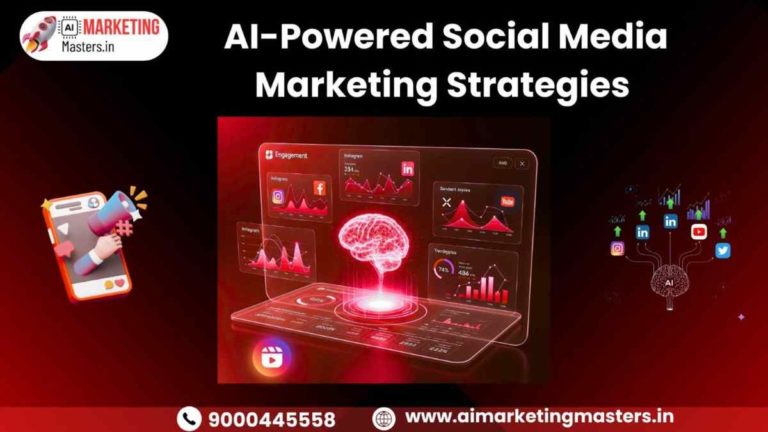
AI-Powered Social Media Marketing Strategies
AI-powered social media marketing uses artificial intelligence to research audiences, generate content ideas, personalize posts, optimize ad spend, and analyze performance at scale. It helps marketers work faster and make more informed decisions, but it works best paired with human strategy, brand judgment, and editorial review. Businesses of every size can use it to compete more efficiently — not to replace marketing expertise, but to extend it.
★★★★★
4.9/5 rated by 1329+ students · Google Verified
Table of Contents
Introduction
Social media marketing has never moved this fast. New formats launch every few months, algorithms shift without warning, and audiences expect content that feels personal rather than mass-produced. Into that environment has arrived artificial intelligence — and it’s changing how brands plan, create, and measure their social presence.
AI-powered social media marketing strategies use machine learning and generative AI to support tasks that used to eat up entire workdays: researching what an audience cares about, drafting captions and video concepts, personalizing content for different segments, running smarter ad campaigns, and turning raw engagement data into decisions. Done well, AI doesn’t replace a marketing team — it removes the repetitive groundwork so the team can spend more time on strategy, brand voice, and creative judgment.
Businesses are adopting these tools quickly. According to Salesforce’s State of Marketing 2026 research, the share of marketers using generative AI in at least one workflow has climbed sharply from just over half in 2024 to the high 80s in 2026, and McKinsey’s 2026 global AI survey found that marketing and sales has become the most common function where organizations deploy AI, ahead of areas like supply chain. That’s a meaningful shift from a few years ago, when AI in marketing mostly meant basic scheduling automation.
Still, AI has real limits. It can draft a caption, but it can’t decide what your brand stands for. It can suggest a hashtag, but it can’t sense when a joke will land badly with your audience. It can summarize sentiment data, but it can’t replace the judgment call about whether to respond to a crisis publicly or privately. The businesses getting the most value from AI-powered social media marketing are the ones treating it as a highly capable assistant — not an autopilot — and keeping a human in the loop for anything involving brand voice, sensitive topics, or factual claims.
This guide walks through what AI-powered social media marketing actually means, the strategies that work in practice, how they differ by platform and business type, the tools involved, the metrics that matter, and where the honest limitations are — so you can build a workflow that fits your business rather than chasing every new tool that launches.
AI-Powered Social Media Marketing Strategies
What Is AI-Powered Social Media Marketing?
AI-powered social media marketing is the use of artificial intelligence tools to support research, content creation, personalization, advertising, and analytics across social platforms, while marketers retain control over strategy and final decisions.
In practice, AI can assist with
- Content creation — drafting captions, generating video scripts, suggesting headlines, or producing image concepts
- Audience research — identifying interests, behaviors, and content preferences within a target audience
- Personalization — tailoring messaging or recommendations to different audience segments
- Social listening — tracking brand mentions, competitor activity, and emerging conversations
- Sentiment analysis — gauging whether mentions of a brand or topic skew positive, negative, or neutral
- Hashtag and topic research — surfacing trending or relevant tags and themes
- Campaign planning — organizing content calendars and mapping content to objectives
- Ad optimization — adjusting targeting, bidding, and creative variants based on performance data
- Performance analysis — turning raw metrics into readable patterns and recommendations
- Customer engagement — powering chatbots and first-line responses to common questions
- Workflow automation — scheduling, tagging, and routing content and requests
It’s worth drawing a clear line between AI-assisted marketing and fully automated social media management. AI-assisted marketing means a person is still reviewing, editing, and approving what gets published — AI speeds up the process but doesn’t own the outcome. Fully automated management, where AI generates and publishes content with no human review, is far riskier: it can produce factual errors, tone-deaf posts, or content that drifts from brand guidelines. Most successful brands operate in the assisted category, using automation for logistics (scheduling, tagging, routing) while keeping humans in charge of anything customer-facing that carries brand or reputational risk.
Why AI-Powered Social Media Marketing Strategies Matter
A few converging pressures explain why AI adoption in social media marketing has accelerated so quickly.
Content competition has never been higher. With well over five and a half billion people now using social media worldwide — DataReportal’s Digital 2026 Global Overview Report estimated the figure at roughly 5.66 billion by late 2025, close to 69% of the global population — every brand is competing for attention in increasingly crowded feeds. Standing out requires more content, tested faster, than most teams can produce manually.
Audiences expect personalization. Generic, one-size-fits-all posts perform worse than content tailored to a segment’s interests or stage in the buying journey. AI makes that kind of segmentation practical even for teams without a dedicated data science function.
Speed matters more than ever. Trends move in days, not months, especially on platforms like TikTok and X. AI tools that can generate content variations or flag emerging topics in real time give marketers a genuine speed advantage.
Real-time insight has become table stakes. Waiting for a monthly report to learn a campaign underperformed is no longer competitive. AI-powered analytics dashboards surface issues and opportunities as they happen.
Advertising costs keep climbing. As paid social gets more expensive, the pressure to optimize targeting, creative, and bidding — the areas where AI tools like automated bidding and predictive audience modeling tend to add the most value — has grown accordingly.
Marketing ROI is under scrutiny. Leadership teams increasingly expect marketing to justify spend with data. Duke University’s Fuqua School of Business CMO Survey, based on responses from senior marketing leaders at U.S. companies, found that AI and machine learning’s share of marketing activity roughly doubled between 2022 and 2025, alongside measurable gains in reported sales productivity and lower marketing overhead among AI-adopting teams.
None of this means AI guarantees better results on its own. It means the tools now exist to compete on speed, personalization, and data — and businesses that ignore them are doing more manual work for a shrinking advantage.
Key AI-Powered Social Media Marketing Strategies
Here are the strategies delivering the most practical value right now.
- AI-powered audience research. AI tools can analyze large volumes of public data — interests, engagement patterns, common questions — to build a clearer picture of who your audience actually is, beyond basic demographics. Implementation is straightforward: feed the tool existing customer data or social engagement history and ask it to identify patterns. Human oversight matters here because AI can surface correlations that aren’t causally meaningful; a marketer needs to sanity-check the output against real customer knowledge.
- AI-assisted content ideation. Rather than staring at a blank content calendar, marketers can prompt AI tools for topic angles, seasonal hooks, or content pillars based on audience interests and current trends. This works best as a brainstorming partner — generate ten ideas, keep the two or three that actually fit the brand.
- AI-generated social media content. Drafting captions, short video scripts, or post copy is one of the most common AI use cases. The benefit is speed; the risk is genericness. Every AI draft should be edited for brand voice, accuracy, and specificity before it goes anywhere near “publish.”
- Personalized content recommendations. AI can help tailor which content a segment sees, whether through paid targeting or on-platform recommendation logic, increasing relevance without manually building dozens of variants.
- AI-powered social listening. Tools can scan mentions, hashtags, and comments across platforms to flag conversations relevant to a brand or industry — far faster than manual monitoring. This is valuable for both opportunity-spotting and early crisis detection.
- Sentiment analysis. By classifying mentions as positive, negative, or neutral at scale, AI gives a quick read on brand perception. It’s directional, not definitive — nuance, sarcasm, and cultural context can trip up automated sentiment scoring, so spot-checking matters.
- AI hashtag and keyword research. AI tools can surface trending and relevant tags faster than manual searching, helping content get discovered without guesswork.
- Automated content scheduling. This is the most mature and lowest-risk use of automation — queuing approved content to publish at optimal times across platforms and time zones.
- AI-powered social media advertising. Platforms like Meta increasingly use AI for automated bidding, audience expansion, and creative testing, often outperforming manual campaign management on efficiency metrics like cost per result.
- Predictive analytics. AI can model likely outcomes — which content types, posting times, or audience segments are likely to perform — based on historical data, helping teams prioritize where to invest effort.
- AI-assisted influencer marketing. AI tools can help identify relevant creators based on audience overlap and engagement authenticity, and can flag signs of inflated or bot-driven followings.
- Automated customer support. Chatbots handle routine questions (hours, shipping, basic troubleshooting) on social platforms, freeing human support for complex or sensitive issues.
- Competitor analysis using AI. AI tools can track competitor posting frequency, engagement, and content themes, giving marketers a faster competitive read than manual audits.
- Social media performance optimization. AI can flag underperforming content patterns and recommend adjustments — posting times, formats, or messaging — based on what has worked historically.
- AI-powered content repurposing. Turning one piece of long-form content (a blog post, webinar, or podcast) into multiple social formats is a natural AI use case, since it involves reformatting existing ideas rather than generating new ones from scratch.
Across all fifteen strategies, the pattern is consistent: AI handles the volume and the first draft; a human handles judgment, accuracy, and final approval.
How AI Is Changing Social Media Content Creation
AI now touches nearly every stage of the content workflow — generating initial ideas, drafting captions and video scripts, suggesting headlines and hooks, building out content calendars, proposing image concepts, repurposing long-form material into shorter formats, and producing A/B test variations to see what resonates.
This has genuinely sped up production. What might have taken a content team a full day — brainstorming, drafting, and formatting a week’s worth of posts — can now happen in a fraction of the time with AI handling the first pass.
If you want to go deeper on getting AI-drafted copy to actually sound like your brand, that’s the specific focus of a dedicated AI Content Writing Course rather than something this guide can fully cover.
But speed introduces a real risk: AI-generated content can be generic, factually shaky, or subtly off-brand if it goes out unreviewed. Language models can state incorrect information confidently, misjudge tone for a sensitive topic, or produce phrasing that sounds like every other brand using the same tool. That’s why every reputable AI-assisted workflow includes a human review stage — checking facts, sharpening the voice, and making sure the content actually reflects how the brand would say it, not just a plausible-sounding version of it.
AI Tools for Social Media Marketing
Rather than a promotional list, it’s more useful to understand the categories of tools in use and where each tends to add value
- Content writing — general-purpose AI assistants like ChatGPT, Claude, and Google Gemini are commonly used for drafting captions, scripts, and content ideas
- Image generation — tools built into platforms like Canva and Adobe’s Creative Cloud apps for generating or editing visual concepts (this is also where a focused AI Graphic Design Course can help if visuals are a weak point for your team)
- Video creation — AI-assisted editing and script-to-video tools that speed up short-form video production, a skill set covered in more depth in an AI Video Creation Course
- Social media scheduling — platforms such as Hootsuite and Buffer, which increasingly bundle AI caption suggestions and optimal-time recommendations into their scheduling features
- Social listening — tools like Sprout Social that use AI to classify sentiment and surface relevant conversations at scale
- Analytics — AI-assisted dashboards within platforms like HubSpot that translate raw engagement data into readable trends
- Advertising — Meta’s advertising products increasingly rely on AI for automated bidding, audience expansion, and creative testing
- Customer engagement — AI chatbots integrated into Messenger, Instagram DMs, and similar channels
- Workflow automation — tools that route approvals, tag content, and manage cross-platform publishing schedules
Capabilities vary by vendor and change frequently, so it’s worth testing a tool against your actual workflow rather than relying on marketing claims about what it can do.
AI-Powered Social Media Marketing Strategies for Small Businesses
Small businesses don’t need an enterprise marketing stack to benefit from AI — often a single AI writing assistant paired with a scheduling tool covers most of the workflow.
A realistic low-budget approach: use a general AI assistant to brainstorm a month of content pillars and draft captions, a free or low-cost design tool for visuals, and a scheduling tool’s built-in analytics to see what’s working. Local businesses can use AI to draft location-specific posts and respond faster to reviews; e-commerce sellers can use it to generate product description variants for different platforms; service businesses and freelancers can use it to turn client work into case-study-style posts; and educational institutions or personal brands can use it to repurpose long-form content (a course module, a newsletter) into a week of social posts.
The common thread: AI does the first draft across all of these, and the business owner or a part-time marketer spends their limited time on the parts that actually require their judgment — accuracy, tone, and deciding what’s worth posting at all.
AI Social Media Marketing Strategies for Different Platforms
AI strategies aren’t one-size-fits-all — what works varies meaningfully by platform.
With over 3 billion monthly active users globally — including more than 700 million users in India alone, according to NapoleonCat’s India social media statistics — Facebook remains a strong fit for AI-driven ad personalization, audience insight tools, and automated engagement through Messenger. Its mature ad platform benefits especially from AI-optimized bidding and audience targeting.
AI is useful here for generating Reels concepts, drafting captions in a consistent brand voice, suggesting relevant hashtags, and analyzing which visual styles get the most engagement from a given audience.
For professional and B2B content, AI can help draft thought-leadership posts, identify relevant industry conversations to join, and support lead-generation messaging — though LinkedIn audiences tend to penalize content that reads as obviously AI-generated, so editing for a genuine, specific voice matters more here than almost anywhere else.
YouTube
AI supports topic research, title and description optimization, script drafting, and repurposing long-form video into shorts — plus audience-retention analysis to identify where viewers drop off.
X (formerly Twitter)
Real-time trend monitoring and social listening are where AI adds the most value on X, given how fast conversations move. Short-form drafting tools can help marketers respond to trends quickly, though timing and cultural awareness still require a human check.
TikTok
AI is widely used for trend discovery, generating hook ideas for the first few seconds of a video, and analyzing what’s currently resonating with a target demographic — a platform where trends shift within days.
It’s worth being direct: no single AI-generated strategy performs equally well across all six platforms. Audience expectations, content formats, and algorithm behavior differ enough that a “post everywhere the same way” approach — even with AI assistance — tends to underperform a tailored one.
AI-Powered Social Media Marketing Strategies for B2B Businesses
B2B marketing benefits from AI in somewhat different ways than consumer brands. Key applications include AI-assisted lead generation and account research (identifying companies and contacts that match an ideal customer profile), drafting LinkedIn thought-leadership content, segmenting audiences by industry or role, personalizing outreach at scale, supporting lead nurturing sequences, social listening for account-based conversations, monitoring competitor positioning, and measuring which content actually influences pipeline rather than just engagement.
A practical B2B workflow: use AI to research target accounts and draft an initial content calendar around their pain points, personalize outreach templates by industry, monitor social listening for buying signals, and route qualified engagement to sales — with a human reviewing anything that goes out under an individual’s name, since B2B buyers tend to notice generic AI phrasing quickly.
AI-Powered Social Media Marketing Strategies for E-Commerce
E-commerce brands can use AI for product description and content generation at scale, personalized product recommendations based on browsing or purchase history, social advertising optimization, customer segmentation for targeted promotions, retargeting campaigns, analysis of user-generated content and reviews, AI-assisted customer support for order questions, and conversion-focused testing of different creative and copy variants.
The advantage for e-commerce specifically is volume: a catalog with hundreds of products benefits enormously from AI handling first-draft descriptions and ad variants that would be impractical to write manually at that scale — while a human still reviews for accuracy on pricing, availability, and claims.
Benefits of AI-Powered Social Media Marketing
The most commonly reported benefits include faster content production, improved personalization at scale, better audience understanding through data analysis, more efficient team workflows, more data-driven decision-making, improved campaign optimization (particularly in paid ads), scalable content creation for larger catalogs or multi-platform presences, faster response times in customer engagement, better performance tracking, and — for many teams — a genuine improvement in marketing efficiency. The 2025 Duke Fuqua CMO Survey, for instance, found AI-adopting marketing teams reporting measurable gains in sales productivity and reductions in marketing overhead compared to prior years.
It’s worth being honest, though: these benefits aren’t automatic. Results depend heavily on implementation quality, audience fit, platform choice, the strength of the underlying creative, budget, and how well AI is integrated into a broader marketing strategy rather than used as a standalone tactic.
Challenges and Limitations of AI in Social Media Marketing
AI-powered marketing comes with real trade-offs that deserve honest attention
- Generic or repetitive content — without careful prompting and editing, AI output can sound interchangeable across brands
- Incorrect AI-generated information — language models can state inaccurate facts with total confidence, which is especially risky for claims about products, pricing, or health and financial topics
- Brand voice inconsistencies — AI drafts often need significant editing to match an established brand tone
- Bias in AI outputs — models can reflect biases present in their training data, which matters for anything touching sensitive demographic or cultural topics
- Privacy concerns — using customer data to train or personalize AI tools raises legitimate data-handling questions
- Copyright considerations — AI-generated images and text can raise ownership and originality questions that are still being worked out legally in many jurisdictions
- Over-automation — publishing AI content without review increases the risk of embarrassing or off-brand posts
- Loss of human creativity — leaning too heavily on AI can make a brand’s content feel less distinctive over time
- Platform policy changes — social platforms are actively updating rules around AI-generated and AI-labeled content
- Dependence on third-party AI tools — pricing, capabilities, and availability of AI tools can change with little notice
- Need for human review — every point above ultimately comes back to this one
The honest takeaway: AI should support marketing decision-making, not replace it. The teams getting burned by AI in social media are almost always the ones that skipped the human review step to save time.
AI vs Traditional Social Media Marketing
Area | Traditional Social Media Marketing | AI-Powered Social Media Marketing |
Content Creation | Manually written and designed, slower turnaround | AI-assisted drafting speeds up first drafts; still needs human editing |
Audience Research | Manual surveys, basic platform analytics | AI can process larger datasets to surface patterns faster |
Personalization | Broad audience segments, limited variation | Finer-grained segmentation and tailored messaging at scale |
Analytics | Manual reporting, often delayed | Near real-time dashboards and AI-generated summaries |
Automation | Basic scheduling only | Scheduling plus content suggestions, tagging, and routing |
Campaign Optimization | Manual A/B testing, slower iteration | AI can test and adjust creative or bids continuously |
Scalability | Limited by team size and hours available | Higher content and campaign volume achievable with the same team |
Human Involvement | High across every stage | Concentrated on strategy, review, and final approval |
This comparison isn’t a case for AI being universally superior — traditional methods still offer more direct control and, in some cases, more distinctly human creative output. The realistic picture is a hybrid: AI for speed and scale, human judgment for everything that determines whether content actually represents the brand well.
AI-Powered Social Media Marketing Strategies vs Social Media Automation
These terms get used interchangeably, but they’re not the same thing. Artificial intelligence refers to systems that can learn patterns and generate new content or predictions.
Marketing automation is broader — any software that triggers actions (emails, posts, follow-ups) based on rules or schedules, with or without AI involved. Social media scheduling is a narrow form of automation: queuing pre-approved content to publish at set times. Rule-based automation follows fixed if-this-then-that logic with no learning component. Generative AI, specifically, is the subset capable of producing new text, images, or video from a prompt.
In practice, most modern marketing stacks blend these — a scheduling tool (automation) might use generative AI to suggest caption variants, while rule-based automation still handles simple, repetitive tasks like tagging or basic customer-service routing. Understanding the distinction matters mainly for evaluating tools accurately: a “smart scheduler” and a genuinely generative AI assistant solve different problems.
How to Build an AI-Powered Social Media Marketing Workflow
A practical, step-by-step approach
- Define business objectives — awareness, engagement, leads, or sales; the goal shapes every downstream choice
- Identify the target audience — who you’re actually trying to reach, beyond broad demographics
- Research audience interests — use AI-assisted listening tools to understand what that audience cares about
- Analyze competitors — see what’s working (and not) for similar brands
- Build content pillars — three to five recurring themes that anchor your calendar
- Generate content ideas — use AI to brainstorm within those pillars
- Create and refine content — draft with AI, then edit for accuracy, voice, and specificity
- Personalize content for platforms — adapt format and tone per channel rather than cross-posting identically
- Schedule and publish — use automation for logistics, not decision-making
- Monitor engagement — track how content performs in near real time
- Analyze performance — use AI-assisted analytics to spot patterns
- Optimize future campaigns — feed what you learn back into the next content cycle
Human review belongs at steps 7 (before anything publishes) and 11–12 (before drawing conclusions from the data) at minimum — those are the points where AI’s blind spots are most likely to cause real problems.
Measuring the Success of AI-Powered Social Media Marketing
Different objectives call for different KPIs
- Awareness goals: reach, impressions, follower growth
- Engagement goals: engagement rate, video views, watch time
- Traffic goals: click-through rate, referral traffic to your site
- Lead generation goals: number of leads, cost per lead
- Sales goals: conversions, customer acquisition cost, return on ad spend, overall return on investment
AI-assisted analytics tools can help surface which of these metrics are trending in a useful direction and flag anomalies faster than manual reporting — but the choice of which metrics matter still depends entirely on the underlying business goal, not on what the dashboard happens to highlight. HubSpot’s State of Marketing 2026 report is a useful benchmark here, since it tracks how AI adoption is actually changing which metrics marketing teams prioritize year over year.
AI-Powered Social Media Marketing Career Opportunities
AI is reshaping — not eliminating — social media marketing roles. Social Media Managers and Strategists increasingly need to know how to direct AI tools effectively rather than write every post from scratch. Digital Marketing Specialists and Content Strategists benefit from understanding how to prompt, edit, and fact-check AI output. Performance Marketers and Social Media Analysts are leaning more on AI-assisted analytics to interpret larger datasets faster. And newer roles — AI Marketing Specialist and Marketing Automation Specialist — have emerged specifically to manage the tools, workflows, and governance around AI use in marketing teams.
For anyone building a career here, AI digital marketing jobs increasingly reward people who combine traditional marketing fundamentals with fluency in AI tools, rather than people who rely on AI as a substitute for marketing knowledge.
Role | Main Focus | Typical Responsibilities | Important Skills |
Social Media Marketer | Day-to-day content and community management | Posting, scheduling, community engagement, basic reporting | Copywriting, platform knowledge, communication |
Content Marketer | Content strategy across formats | Content calendars, brand voice, cross-channel repurposing | Storytelling, SEO basics, editing |
Performance Marketer | Paid campaign results | Ad management, bidding, budget optimization | Analytics, paid media platforms, testing |
AI Marketing Specialist | AI tool strategy and governance | Tool selection, prompt design, workflow automation, quality control | Prompt engineering, data literacy, marketing fundamentals |
This table describes distinct focus areas rather than a hierarchy — most marketing teams need a mix of these skill sets, whether spread across several people or combined in one generalist role.
Future of AI-Powered Social Media Marketing
Some developments here are already established; others are early and worth flagging as such.
Established and growing: generative AI for content drafting, AI-powered social listening and sentiment analysis, predictive analytics for campaign planning, and conversational AI (chatbots) for customer engagement are all in active, mainstream use today.
Emerging, with more uncertainty: AI agents that can independently execute multi-step marketing tasks, hyper-personalization at an individual (not just segment) level, AI-powered social commerce that blends shopping directly into social content, synthetic media (AI-generated video and voice) at production quality, multimodal AI that can reason across text, image, and video together, and real-time audience analysis that adjusts content mid-campaign are all developing quickly but are not yet as reliable or widely adopted as the established category above.
Marketers should treat the second group as directions to watch and experiment with cautiously — not as capabilities to build an entire strategy around just yet.
Why AI-Powered Social Media Marketing Strategies Are Important for Modern Businesses
Consumer behavior keeps shifting toward platforms that reward speed, personalization, and authenticity simultaneously — a genuinely difficult combination to deliver manually at scale. Competition for attention keeps increasing as more brands and creators enter every platform. Content cycles have compressed from weeks to days. Audiences expect content that feels relevant to them specifically, not generic. Data-driven decision-making has become the norm rather than the exception. Most brands now run campaigns across multiple platforms simultaneously, each with different content demands. And operational efficiency — doing more with the same team size — matters more as marketing budgets face increased scrutiny.
None of this means AI guarantees growth, leads, or ROI — it doesn’t, and any strategy that promises otherwise deserves skepticism. What AI does offer is the ability to compete on speed and personalization without proportionally increasing headcount, provided the technology is paired with real human creativity and strategic thinking rather than used as a replacement for it.
How to Start Using AI for Social Media Marketing
A practical path for beginners, freelancers, small businesses, and marketing students alike:
Step 1: Learn social media fundamentals. Understand platform basics, audience behavior, and content formats before layering on AI — the tools are far more useful once you know what “good” looks like.
Step 2: Select relevant AI tools. Start with one general-purpose AI writing assistant and one scheduling tool rather than trying to adopt an entire stack at once.
Step 3: Define your content strategy. Decide on goals and target audience before generating any content.
Step 4: Build content pillars. Choose three to five recurring themes to keep AI-generated ideas focused and on-brand.
Step 5: Create a content calendar. Use AI to help populate it, then review for balance and relevance.
Step 6: Test AI-assisted content. Publish a small batch, track performance, and see what resonates before scaling up.
Step 7: Measure results. Track the KPIs that match your actual goals, not just whatever the dashboard surfaces first.
Step 8: Improve based on data. Feed learning back into your next round of content and campaign planning.
For beginners and students, this is also a genuinely useful way to build a professional skill set — employers increasingly expect comfort with AI tools alongside traditional marketing knowledge. For small businesses and freelancers, starting with one or two tools and expanding gradually beats trying to overhaul an entire workflow at once.
Key Takeaways
- AI speeds up research, content creation, personalization, and analytics — but human strategy and brand judgment remain essential for good results.
- The strongest AI-powered social media marketing strategies (audience research, content ideation, ad optimization, sentiment analysis) work best when paired with clear human review before anything is published.
- Results depend heavily on implementation quality, audience fit, and platform-specific tailoring — no single AI strategy performs equally well everywhere.
- Measuring success means matching KPIs to actual business goals, not just tracking whatever metrics an AI dashboard highlights first.
- The field is still evolving quickly; established uses like content drafting and social listening are reliable today, while AI agents and hyper-personalization remain early and worth testing cautiously rather than betting a whole strategy on.
Conclusion
AI-powered social media marketing strategies have moved from experimental to mainstream, giving businesses of every size a genuine way to produce more content, understand their audience better, and run smarter campaigns without proportionally increasing their team. But the technology works best as an accelerant for good marketing, not a replacement for it — the brands seeing real results are the ones combining AI’s speed with human creativity, editorial judgment, and honest fact-checking.
If you’re just getting started, there’s no need to overhaul your entire workflow overnight. Pick one or two AI tools, apply them to a specific part of your process — content drafting, audience research, or ad optimization — and build from there based on what actually moves your numbers. Done thoughtfully, AI-powered social media marketing strategies can make a real difference in how efficiently and effectively your brand shows up on social media, without promising outcomes no strategy can honestly guarantee.
If you’d rather learn all of this hands-on with live tools, real campaigns, and mentor guidance instead of piecing it together on your own, that’s exactly what our Digital Marketing with AI Course in Hyderabad
FAQ
- What is AI-powered social media marketing?
It’s the use of artificial intelligence tools to support content creation, audience research, personalization, advertising, and analytics on social platforms, with human marketers still directing strategy and reviewing output.
- How is AI used in social media marketing?
AI supports tasks like drafting captions and video scripts, researching audience interests, personalizing content for segments, optimizing ad targeting and bidding, analyzing sentiment and performance data, and powering customer-service chatbots.
- What are the benefits of using AI for social media marketing?
Key benefits include faster content production, better personalization, more efficient workflows, more data-driven decisions, and improved ad campaign optimization — though results depend heavily on how well the tools are implemented.
- Can AI create social media content?
Yes — AI can draft captions, generate video concepts, and suggest headlines, but AI-generated content should always be reviewed and edited by a human before publishing to check for accuracy, tone, and brand fit.
- What are the best AI tools for social media marketing?
There’s no single “best” tool; the right choice depends on the task. Common categories include AI writing assistants (like ChatGPT, Claude, or Gemini) for content, Canva or Adobe tools for visuals, and scheduling platforms like Hootsuite or Buffer that now include built-in AI features.
- Can AI automate social media marketing?
AI can automate parts of the workflow — scheduling, content suggestions, basic customer responses — but full automation without human review carries real risk of factual errors or off-brand content, so most effective workflows keep a human review step.
- Is AI going to replace social media marketers?
Unlikely in the near term. AI is changing what the role involves — more tool direction and less manual drafting — but strategy, brand judgment, and creative decision-making remain distinctly human tasks that AI can’t reliably replicate.
- How can small businesses use AI for social media marketing?
Small businesses can start with a single AI writing assistant for content drafts and a scheduling tool for publishing, gradually adding audience research or analytics tools as the workflow matures — no large marketing team required.
- How do you measure AI-powered social media marketing results?
Track KPIs that match your specific goal: reach and impressions for awareness, engagement rate and watch time for engagement, click-through rate for traffic, cost per lead for lead generation, and conversion rate or ROAS for sales.
- What skills are needed for AI social media marketing?
A mix of traditional marketing skills (copywriting, strategy, analytics, creativity) and newer AI-specific skills (prompt engineering, tool fluency, and fact-checking AI output) tends to produce the strongest results.

AI Marketing Trainer
AI Marketing Masters Editorial Team |
Ambica brings over 8+ years of hands on experience in the digital marketing industry, having worked closely with startups and small businesses to boost their online presence through effective, performance driven strategies.
Share